JEE Challenger
More from Thermodynamics

Ratio of Work Done Along Two Paths for Ideal Gas

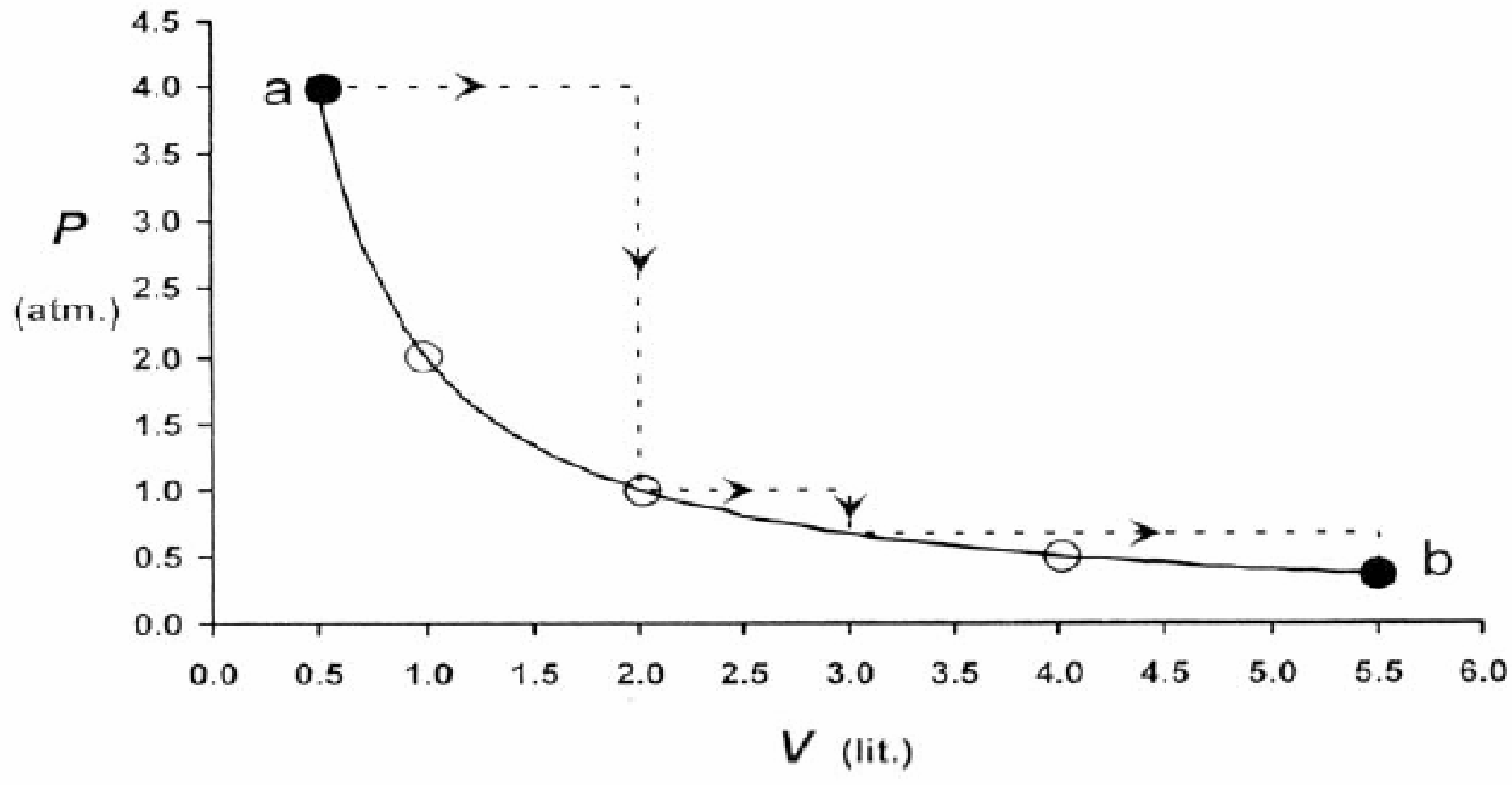
One mole of an ideal gas is taken from a\mathbf{a} to b\mathbf{b} along two paths denoted by the solid and the dashed lines as shown in the graph below. If the work done along the solid line path is wsw_s and that along the dotted line path is wdw_d, then the integer closest to the ratio wd/wsw_d/w_s is

Diagram 0

Official Numerical Answer2

Step-by-Step Solution

To find the ratio of the work done along the dashed line path (wdw_d) to the solid line path (wsw_s), we analyze the two thermodynamic paths using the given PP-VV graph.

1. Work Done Along the Solid Line Path (wsw_s)

From the graph, the solid curve represents an isothermal expansion process for an ideal gas where P⋅V=constantP \cdot V = \text{constant}:

  • At point a\mathbf{a}: Pa=4.0 atmP_a = 4.0\text{ atm} and Va=0.5 LV_a = 0.5\text{ L}, so PaVa=2.0 atm⋅LP_a V_a = 2.0\text{ atm}\cdot\text{L}.
  • At intermediate points indicated by circles:
    • P=2.0 atm,V=1.0 L  ⟹  PV=2.0 atm⋅LP = 2.0\text{ atm}, V = 1.0\text{ L} \implies PV = 2.0\text{ atm}\cdot\text{L}
    • P=1.0 atm,V=2.0 L  ⟹  PV=2.0 atm⋅LP = 1.0\text{ atm}, V = 2.0\text{ L} \implies PV = 2.0\text{ atm}\cdot\text{L}
    • P=0.5 atm,V=4.0 L  ⟹  PV=2.0 atm⋅LP = 0.5\text{ atm}, V = 4.0\text{ L} \implies PV = 2.0\text{ atm}\cdot\text{L}
  • At point b\mathbf{b}: Vb=5.5 LV_b = 5.5\text{ L}.

The work done along an isothermal process is given by:
ws=∫VaVbP dV=PaValn⁡(VbVa)w_s = \int_{V_a}^{V_b} P \, dV = P_a V_a \ln\left(\frac{V_b}{V_a}\right)

Substituting the values:
ws=2.0ln⁡(5.50.5)=2ln⁡(11)w_s = 2.0 \ln\left(\frac{5.5}{0.5}\right) = 2 \ln(11)

Since ln⁡(11)≈2.398\ln(11) \approx 2.398:
ws≈2×2.398=4.796 atm⋅Lw_s \approx 2 \times 2.398 = 4.796\text{ atm}\cdot\text{L}


2. Work Done Along the Dashed Line Path (wdw_d)

The dashed path consists of horizontal (isobaric expansion) and vertical (isochoric) segments:

  1. First isobaric expansion at P1=4.0 atmP_1 = 4.0\text{ atm} from V=0.5 LV = 0.5\text{ L} to V=2.0 LV = 2.0\text{ L}:
    w1=P1ΔV1=4.0×(2.0−0.5)=6.0 atm⋅Lw_1 = P_1 \Delta V_1 = 4.0 \times (2.0 - 0.5) = 6.0\text{ atm}\cdot\text{L}

  2. First isochoric pressure drop at V=2.0 LV = 2.0\text{ L} from P=4.0 atmP = 4.0\text{ atm} to P=1.0 atmP = 1.0\text{ atm}:
    w2=0w_2 = 0

  3. Second isobaric expansion at P2=1.0 atmP_2 = 1.0\text{ atm} from V=2.0 LV = 2.0\text{ L} to V=3.0 LV = 3.0\text{ L}:
    w3=P2ΔV2=1.0×(3.0−2.0)=1.0 atm⋅Lw_3 = P_2 \Delta V_2 = 1.0 \times (3.0 - 2.0) = 1.0\text{ atm}\cdot\text{L}

  4. Second isochoric pressure drop at V=3.0 LV = 3.0\text{ L} from P=1.0 atmP = 1.0\text{ atm} to P3≈23 atm≈0.67 atmP_3 \approx \frac{2}{3}\text{ atm} \approx 0.67\text{ atm}:
    w4=0w_4 = 0

  5. Third isobaric expansion at P3≈23 atmP_3 \approx \frac{2}{3}\text{ atm} from V=3.0 LV = 3.0\text{ L} to V=5.5 LV = 5.5\text{ L}:
    w5=P3ΔV3=23×(5.5−3.0)=23×2.5=53≈1.67 atm⋅Lw_5 = P_3 \Delta V_3 = \frac{2}{3} \times (5.5 - 3.0) = \frac{2}{3} \times 2.5 = \frac{5}{3} \approx 1.67\text{ atm}\cdot\text{L}

Summing the work done along each step:
wd=w1+w2+w3+w4+w5=6.0+0+1.0+0+1.67=8.67 atm⋅Lw_d = w_1 + w_2 + w_3 + w_4 + w_5 = 6.0 + 0 + 1.0 + 0 + 1.67 = 8.67\text{ atm}\cdot\text{L}


3. Ratio wd/wsw_d / w_s

wdws=8.674.796≈1.81\frac{w_d}{w_s} = \frac{8.67}{4.796} \approx 1.81

The integer closest to 1.811.81 is 22.