Ratio of Elongations in Suspended Wires Supporting a Block
A block weighing is suspended by copper and steel wires having identical cross-sectional areas of and lengths of and , respectively. Their other ends are fixed to a ceiling as shown in the figure. The angles made by the copper and steel wires with the ceiling are and , respectively. If the elongation in the copper wire is and in the steel wire is , determine the value of the ratio .
[Given: Young's modulus for copper and steel are and , respectively.]
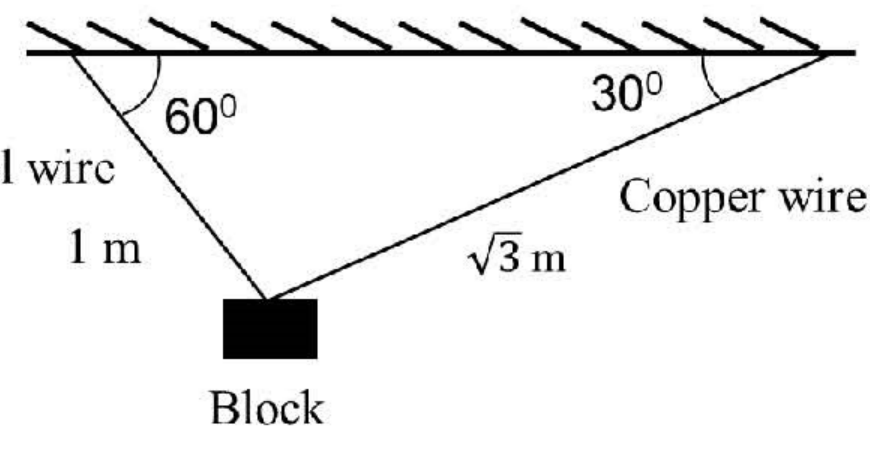
Topics & Concepts
Step-by-Step Solution
To find the ratio of elongations in the copper and steel wires, , we analyze the system in equilibrium and apply Hooke's Law.
Step 1: Equilibrium of Tensions in the Wires
Let and be the tensions in the steel wire and copper wire, respectively.
Resolving forces horizontally for the suspended block:
Substituting the values of the trigonometric ratios:
Step 2: Formula for Elongation
From Young's Modulus definition, the elongation in a wire of length , cross-sectional area , and Young's modulus under tension is given by:
Thus, the elongations in the copper and steel wires are:
Step 3: Calculating the Ratio
Taking the ratio of the two elongations:
Given data:
- Length ratio:
- Area ratio:
- Young's moduli ratio:
Substituting these values into the ratio equation:
Thus, the ratio is .