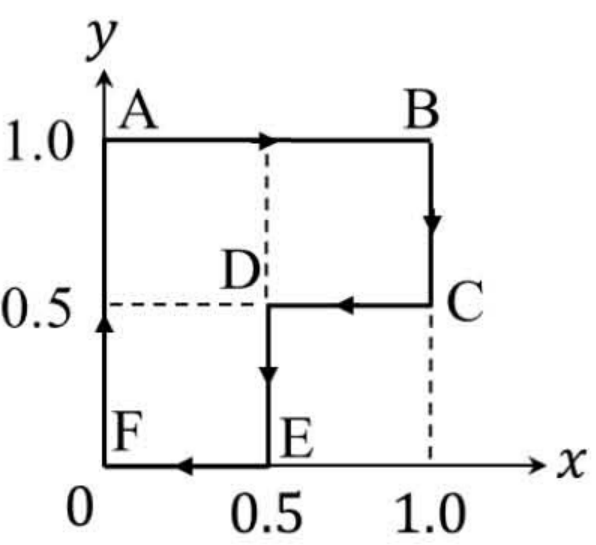
To find the total work done on the particle by the force F ⃗ = ( α y i ^ + 2 α x j ^ ) N \vec{F} = (\alpha y\hat{i} + 2\alpha x\hat{j})\text{ N} F = ( α y i ^ + 2 α x j ^ ) N A B − B C − C D − D E − E F − F A AB-BC-CD-DE-EF-FA A B − B C − C D − D E − E F − F A
W = ∮ F ⃗ ⋅ d r ⃗ = ∮ ( F x d x + F y d y ) = ∮ ( α y d x + 2 α x d y ) W = \oint \vec{F} \cdot d\vec{r} = \oint (F_x dx + F_y dy) = \oint (\alpha y dx + 2\alpha x dy) W = ∮ F ⋅ d r = ∮ ( F x d x + F y d y ) = ∮ ( α y d x + 2 α x d y )
Given parameters:
α = − 1 N m − 1 \alpha = -1\text{ N m}^{-1} α = − 1 N m − 1 Path coordinates:
A ( 0 , 1.0 ) A(0, 1.0) A ( 0 , 1.0 ) B ( 1.0 , 1.0 ) B(1.0, 1.0) B ( 1.0 , 1.0 ) C ( 1.0 , 0.5 ) C(1.0, 0.5) C ( 1.0 , 0.5 ) D ( 0.5 , 0.5 ) D(0.5, 0.5) D ( 0.5 , 0.5 ) E ( 0.5 , 0 ) E(0.5, 0) E ( 0.5 , 0 ) F ( 0 , 0 ) F(0, 0) F ( 0 , 0 )
We can calculate the work done segment by segment along the path:
Segment AB: From ( 0 , 1.0 ) (0, 1.0) ( 0 , 1.0 ) ( 1.0 , 1.0 ) (1.0, 1.0) ( 1.0 , 1.0 )
y = 1.0 ⟹ d y = 0 y = 1.0 \implies dy = 0 y = 1.0 ⟹ d y = 0 x x x 0 0 0 1.0 1.0 1.0 W A B = ∫ 0 1.0 α ( 1.0 ) d x = α [ x ] 0 1.0 = α = − 1 J W_{AB} = \int_{0}^{1.0} \alpha (1.0) dx = \alpha [x]_0^{1.0} = \alpha = -1\text{ J} W A B = ∫ 0 1.0 α ( 1.0 ) d x = α [ x ] 0 1.0 = α = − 1 J
Segment BC: From ( 1.0 , 1.0 ) (1.0, 1.0) ( 1.0 , 1.0 ) ( 1.0 , 0.5 ) (1.0, 0.5) ( 1.0 , 0.5 )
x = 1.0 ⟹ d x = 0 x = 1.0 \implies dx = 0 x = 1.0 ⟹ d x = 0 y y y 1.0 1.0 1.0 0.5 0.5 0.5 W B C = ∫ 1.0 0.5 2 α ( 1.0 ) d y = 2 α [ y ] 1.0 0.5 = 2 α ( 0.5 − 1.0 ) = − α = 1 J W_{BC} = \int_{1.0}^{0.5} 2\alpha (1.0) dy = 2\alpha [y]_{1.0}^{0.5} = 2\alpha (0.5 - 1.0) = -\alpha = 1\text{ J} W B C = ∫ 1.0 0.5 2 α ( 1.0 ) d y = 2 α [ y ] 1.0 0.5 = 2 α ( 0.5 − 1.0 ) = − α = 1 J
Segment CD: From ( 1.0 , 0.5 ) (1.0, 0.5) ( 1.0 , 0.5 ) ( 0.5 , 0.5 ) (0.5, 0.5) ( 0.5 , 0.5 )
y = 0.5 ⟹ d y = 0 y = 0.5 \implies dy = 0 y = 0.5 ⟹ d y = 0 x x x 1.0 1.0 1.0 0.5 0.5 0.5 W C D = ∫ 1.0 0.5 α ( 0.5 ) d x = 0.5 α [ x ] 1.0 0.5 = 0.5 α ( 0.5 − 1.0 ) = − 0.25 α = 0.25 J W_{CD} = \int_{1.0}^{0.5} \alpha (0.5) dx = 0.5\alpha [x]_{1.0}^{0.5} = 0.5\alpha (0.5 - 1.0) = -0.25\alpha = 0.25\text{ J} W C D = ∫ 1.0 0.5 α ( 0.5 ) d x = 0.5 α [ x ] 1.0 0.5 = 0.5 α ( 0.5 − 1.0 ) = − 0.25 α = 0.25 J
Segment DE: From ( 0.5 , 0.5 ) (0.5, 0.5) ( 0.5 , 0.5 ) ( 0.5 , 0 ) (0.5, 0) ( 0.5 , 0 )
x = 0.5 ⟹ d x = 0 x = 0.5 \implies dx = 0 x = 0.5 ⟹ d x = 0 y y y 0.5 0.5 0.5 0 0 0 W D E = ∫ 0.5 0 2 α ( 0.5 ) d y = α [ y ] 0.5 0 = α ( 0 − 0.5 ) = − 0.5 α = 0.5 J W_{DE} = \int_{0.5}^{0} 2\alpha (0.5) dy = \alpha [y]_{0.5}^{0} = \alpha (0 - 0.5) = -0.5\alpha = 0.5\text{ J} W D E = ∫ 0.5 0 2 α ( 0.5 ) d y = α [ y ] 0.5 0 = α ( 0 − 0.5 ) = − 0.5 α = 0.5 J
Segment EF: From ( 0.5 , 0 ) (0.5, 0) ( 0.5 , 0 ) ( 0 , 0 ) (0, 0) ( 0 , 0 )
y = 0 ⟹ d y = 0 y = 0 \implies dy = 0 y = 0 ⟹ d y = 0 W E F = ∫ 0.5 0 α ( 0 ) d x = 0 J W_{EF} = \int_{0.5}^{0} \alpha (0) dx = 0\text{ J} W E F = ∫ 0.5 0 α ( 0 ) d x = 0 J
Segment FA: From ( 0 , 0 ) (0, 0) ( 0 , 0 ) ( 0 , 1.0 ) (0, 1.0) ( 0 , 1.0 )
x = 0 ⟹ d x = 0 x = 0 \implies dx = 0 x = 0 ⟹ d x = 0 W F A = ∫ 0 1.0 2 α ( 0 ) d y = 0 J W_{FA} = \int_{0}^{1.0} 2\alpha (0) dy = 0\text{ J} W F A = ∫ 0 1.0 2 α ( 0 ) d y = 0 J
Adding the work done along all individual segments gives the total work done W W W
W = W A B + W B C + W C D + W D E + W E F + W F A W = W_{AB} + W_{BC} + W_{CD} + W_{DE} + W_{EF} + W_{FA} W = W A B + W B C + W C D + W D E + W E F + W F A W = − 1 + 1 + 0.25 + 0.5 + 0 + 0 = 0.75 J W = -1 + 1 + 0.25 + 0.5 + 0 + 0 = 0.75\text{ J} W = − 1 + 1 + 0.25 + 0.5 + 0 + 0 = 0.75 J
(Alternatively, using Green's Theorem for a clockwise oriented closed curve C C C R R R
W = − ∬ R ( ∂ F y ∂ x − ∂ F x ∂ y ) d A = − ∬ R ( 2 α − α ) d A = − α Area ( R ) W = -\iint_R \left(\frac{\partial F_y}{\partial x} - \frac{\partial F_x}{\partial y}\right) dA = -\iint_R (2\alpha - \alpha) dA = -\alpha \text{Area}(R) W = − ∬ R ( ∂ x ∂ F y − ∂ y ∂ F x ) d A = − ∬ R ( 2 α − α ) d A = − α Area ( R ) Area ( R ) = ( 0.5 × 1.0 ) + ( 0.5 × 0.5 ) = 0.75 m 2 \text{Area}(R) = (0.5 \times 1.0) + (0.5 \times 0.5) = 0.75\text{ m}^2 Area ( R ) = ( 0.5 × 1.0 ) + ( 0.5 × 0.5 ) = 0.75 m 2 W = − ( − 1 ) × 0.75 = 0.75 J) W = -(-1) \times 0.75 = 0.75\text{ J}\text{)} W = − ( − 1 ) × 0.75 = 0.75 J )
Final Answer:
The total work performed on the particle by the force F ⃗ \vec{F} F 0.75 Joule.