Beats Frequency Heard by Moving Observer from Two Sound Sources
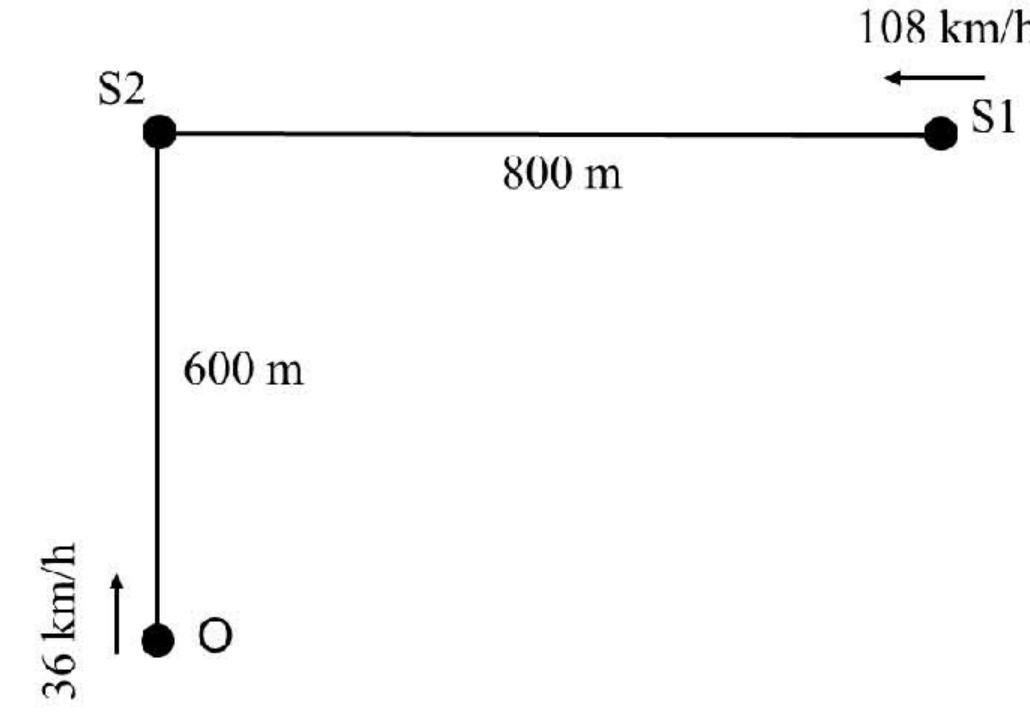
Consider a train S1 moving with a uniform velocity of approaching another train S2 stationary on a platform. An observer O travels toward S2 at a constant speed of , as depicted in the figure. Both trains emit whistles of identical frequency . At the moment when O is away from S2 and the distance separating S1 and S2 is , calculate the number of beats heard per second by observer O. [Given speed of sound in air ]
Topics & Concepts
Step-by-Step Solution
To find the number of beats heard per second by observer , we need to calculate the apparent frequencies of the sound received by from both trains and .
1. Conversion of Given Quantities
- Speed of train :
- Speed of observer :
- Speed of sound in air:
- Frequency emitted by both whistles:
2. Frequency Received from Stationary Source ()
Observer is moving directly towards the stationary train along the line joining them at speed .
Using the Doppler effect formula for a moving observer and a stationary source:
Substituting the values:
3. Frequency Received from Moving Source ()
From the given geometry:
- (along horizontal axis)
- (along vertical axis)
The direct distance between observer and train is:
Let be the angle between the line of motion of and the line joining to :
Now, we resolve the velocities along the line joining and :
- Effective velocity of source towards :
- Effective velocity of observer towards :
Using the Doppler effect formula for relative motion along the line joining source and observer:
Substituting the values:
4. Calculation of Beat Frequency
The number of beats heard per second by observer is given by the difference between the two apparent frequencies:
Taking the common denominator ():
Rounding off to two decimal places, the number of beats heard per second is (or to ).