Ratio of Displacements for Block Connected to Springs with Unattached Supports
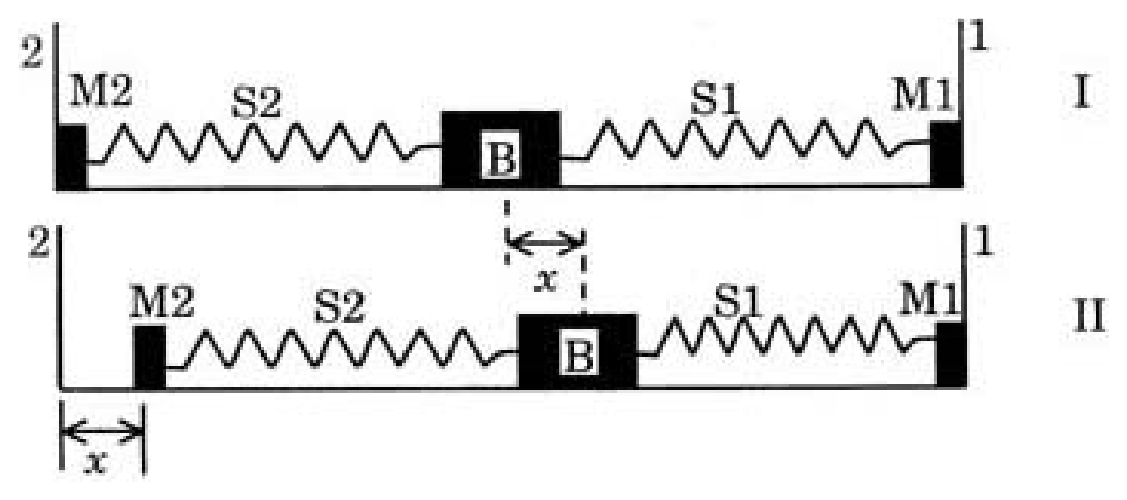
A block (B) is attached to two unstretched springs S1 and S2 with spring constants and , respectively (see figure I). The other ends are attached to identical supports M1 and M2 not attached to the walls. The springs and supports have negligible mass. There is no friction anywhere. The block B is displaced towards wall 1 by a small distance (figure II) and released. The block returns and moves a maximum distance towards wall 2. Displacements and are measured with respect to the equilibrium position of the block B. The ratio is
Options
4
2
Topics & Concepts
Step-by-Step Solution
To find the ratio of the displacements , we analyze the mechanical energy of the system at the two extreme positions using the Principle of Conservation of Mechanical Energy.
1. Initial State (Displacement towards Wall 1):
- When the block is displaced to the right by a distance towards Wall 1:
- Support rests against Wall 1, preventing further movement to the right. Thus, spring (with spring constant ) is compressed by a distance .
- Support is not attached to Wall 2, so as the block moves right, simply slides to the right. Spring (with spring constant ) remains at its relaxed (natural) length.
- Since the block is released from rest, the initial mechanical energy of the system is entirely potential energy stored in spring :
2. Motion towards Wall 2 (Displacement towards Wall 2):
- Upon release, spring pushes the block back towards the equilibrium position (). At , spring reaches its natural length, and support makes contact with Wall 2.
- As the block continues moving to the left beyond the equilibrium position by a maximum distance :
- Support is pressed against Wall 2 and cannot move further left, causing spring to be compressed by distance .
- Support is not attached to Wall 1, so it detaches from Wall 1 and moves along with the block to the left. As a result, spring remains at its natural length and stores zero potential energy.
- At the maximum displacement , the block momentarily comes to rest. The final mechanical energy of the system is entirely potential energy stored in spring :
3. Conservation of Energy:
Since all surfaces are frictionless and the springs/supports are massless, the total mechanical energy is conserved ():
Taking the square root on both sides:
Thus, the correct option is (C).