Velocity of Point on Transverse Sinusoidal Wave
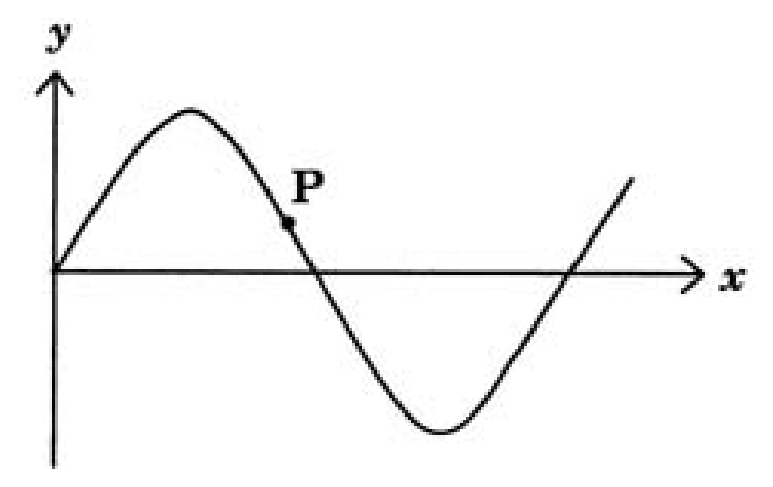
A transverse sinusoidal wave moves along a string in the positive -direction at a speed of . The wavelength of the wave is and its amplitude is . At a particular time , the snap-shot of the wave is shown in figure. The velocity of point P when its displacement is is
Options
Topics & Concepts
Step-by-Step Solution
To find the velocity of point on the string, we first determine the frequency, angular frequency, and magnitude of particle velocity, followed by its direction using the wave profile.
1. Calculation of Wave Parameters
Given:
- Wave speed,
- Wavelength,
- Amplitude,
- Displacement at point ,
The angular frequency of the wave is given by:
2. Magnitude of Particle Velocity
The speed of a particle performing Simple Harmonic Motion at displacement is given by:
Substituting the given values:
3. Direction of Velocity
The particle velocity at any point on a transverse wave traveling in the positive -direction is related to the slope of the wave profile by:
From the given snapshot of the wave:
- At point , the string has a negative slope, i.e., .
- Since (wave travels along ), the particle velocity is:
Thus, the particle at is moving upwards in the positive -direction (). Alternatively, as the wave shifts to the right, the crest approaches point , causing its displacement to increase upwards.
Conclusion
The velocity vector of point is:
Correct Answer: A