Angle at Which Bob Speed is Half Initial Velocity in Vertical Circular Motion
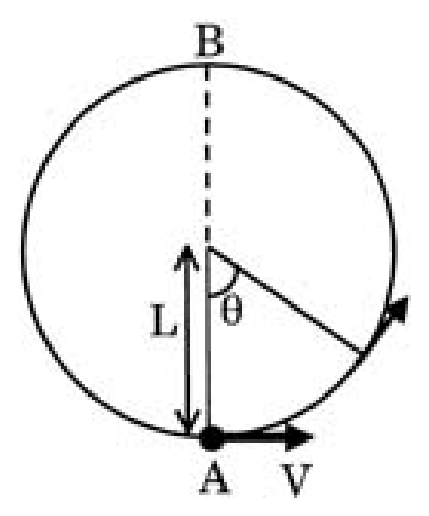
A bob of mass M is suspended by a massless string of length L. The horizontal velocity V at position A is just sufficient to make it reach the point B. The angle at which the speed of the bob is half of that at A, satisfies
Options
Topics & Concepts
Step-by-Step Solution
To find the angle at which the speed of the bob is half of its initial speed at , we analyze the motion using the principle of conservation of mechanical energy.
Step 1: Determine the velocity at
For the bob suspended by a string to just reach the top point of the vertical circular path, the tension in the string at point must be zero ().
At point , gravity provides the required centripetal acceleration:
Using the conservation of mechanical energy between the lowest point (taken as the reference level for potential energy, ) and the highest point (at a height above ):
Step 2: Relate speed at angle to the initial speed
Let be the angle made by the string with the downward vertical line passing through . The height of the bob above point at angle is:
Applying the conservation of mechanical energy between point and the point at angle :
Substituting :
Step 3: Find when
Given that the speed of the bob is half of its velocity at , :
Equating this to the energy expression for :
Step 4: Determine the interval for
We know the standard values of cosine in the second quadrant:
Since , it follows that:
Since is a strictly decreasing function in the range , reversing the inequalities gives:
Thus, the correct option is D.