Potential Difference Induced in Moving Parabolic Wire in Magnetic Field
Consider a conducting wire with a parabolic profile, initially given by , moving at a constant velocity within a non-uniform magnetic field , as depicted in the figure. Here, , , , and represent positive constants. If denotes the potential difference generated across the ends of the wire, select the correct statement(s):
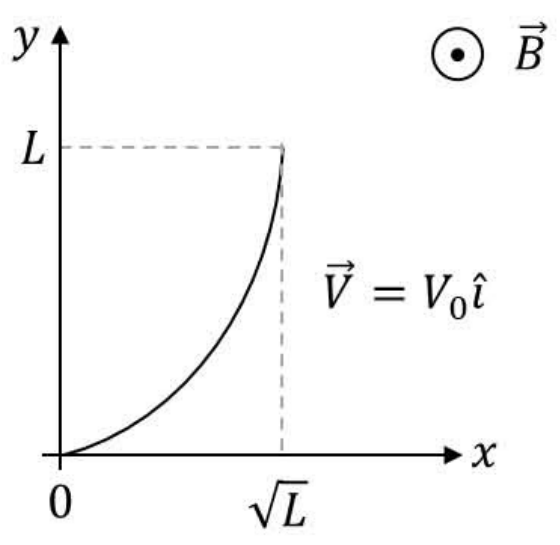
Options
when
when
remains unchanged if the parabolic wire is substituted by a straight wire of length initially along
is directly proportional to the length of the wire projected onto the -axis.
Topics & Concepts
Step-by-Step Solution
To determine the correct statement(s), we calculate the induced electromotive force (potential difference) across the ends of the moving wire using the concept of motional EMF.
1. Derivation of the Induced Potential Difference
The velocity of the wire is given by:
The non-uniform magnetic field is:
The motional electric field vector set up along the conductor due to its motion in the magnetic field is:
For an infinitesimal line element along the wire, , the induced potential difference across this element is:
The total magnitude of the potential difference developed between the ends of the wire (from to ) is:
Evaluating the integral:
2. Evaluation of the Options
-
Option A: For : Hence, Option A is incorrect.
-
Option B: For : Hence, Option B is correct.
-
Option C: The differential potential difference depends solely on the -component of the wire element () and the -coordinate. Replacing the parabolic wire with a straight wire of length extends from to , which corresponds to to . Because the initial and final -limits remain and , the integration result for remains identical. Hence, Option C is correct.
-
Option D: Because of the dependence on inside the integrand, the expression for is not directly proportional to the projected length on the -axis for a general value of . Hence, Option D is incorrect.
Conclusion
The correct options are B and C.