Water Height and Meniscus Correction in Joined Capillary Tubes
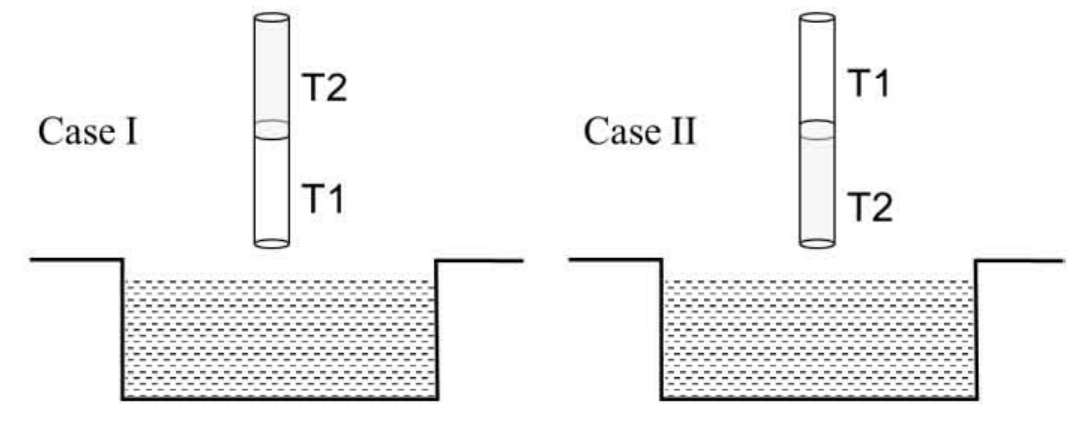
A composite capillary tube with a radius of is formed by joining two individual capillaries and made of different materials, with contact angles for water being and , respectively. This capillary tube is immersed vertically in water in two distinct setups, case I and case II, as depicted in the figure. Which of the following option(s) is/are correct? [Take surface tension of water , density of water , and ]
Options
The height correction for the water column inside the tube, accounting for the weight of water in the meniscus, is distinct for both cases.
For case II, provided the capillary joint is located above the water level, the height of the water column in the tube will be . (Ignore the weight of water in the meniscus)
For case I, provided the joint is positioned above the water surface, the height of the water column in the tube will be . (Ignore the weight of water in the meniscus)
For case I, provided the capillary joint is positioned above the water level, the height of the water column in the tube will exceed . (Ignore the weight of water in the meniscus)
Topics & Concepts
Step-by-Step Solution
To determine the correct options, we analyze the capillary rise in the two individual tubes and .
1. Fundamental Capillary Height Formula
The height to which a liquid rises in a capillary tube of radius is given by:
Given parameters:
- Radius of the capillary tube,
- Surface tension of water,
- Density of water,
- Acceleration due to gravity,
2. Maximum Heights in Individual Tubes
-
For tube (contact angle ):
-
For tube (contact angle ):
3. Evaluation of the Options
-
Option (A): The correction in height due to the weight of water in the meniscus depends on the volume of the meniscus, which is determined by the contact angle at the top surface. Since the meniscus forms with different contact angles in Case I ( or pinned at an intermediate angle) and Case II (), the meniscus shape and volume differ in both cases. Thus, the height corrections are distinct. Option (A) is correct.
-
Option (B): In Case II, tube is at the bottom and is at the top, with the joint at above the water surface. Water rises in up to its maximum capacity of . Since , the water level never reaches the joint, and the height of the column remains . Option (B) is correct.
-
Option (C): In Case I, tube is at the bottom and is at the top, with the joint at above the water surface. Water rises in up to its maximum capacity of . Since , the water level stays inside tube at a height of . Option (C) is correct.
-
Option (D): In Case I, if the joint is at , water rises in up to the joint at . It cannot ascend into tube because can only support a maximum column height of . Instead, the meniscus becomes pinned at the boundary/joint, adjusting its contact angle to satisfy: Hence, the water column height remains fixed at , which is not greater than . Option (D) is incorrect.
Final Answer:
The correct options are A, B, and C.