JEE Challenger
More from Electrostatic Potential and Capacitance

Circuit Transient Analysis with Multiple Capacitors and Switches

In the given electrical circuit, initially no charge exists on the capacitors, and switches S1S_1 and S2S_2 remain open. The capacitance values are given as C1=10 μFC_1 = 10\ \mu\text{F}, C2=30 μFC_2 = 30\ \mu\text{F}, and C3=C4=80 μFC_3 = C_4 = 80\ \mu\text{F}.

Which of the following option(s) is/are correct?
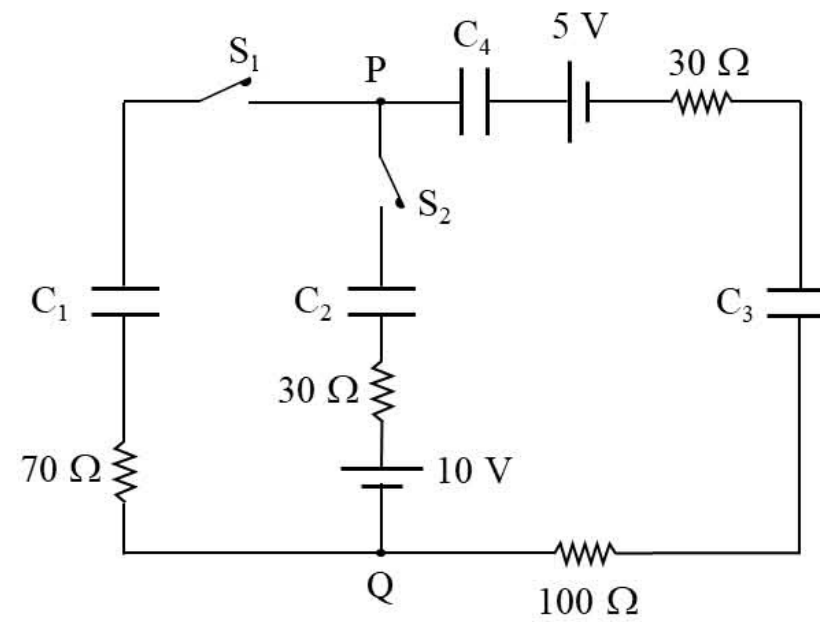
Question Diagram 1

Options

A

At time t=0t = 0, when key S1S_1 is closed, the instantaneous current through the circuit equals 25 mA25\ \text{mA}.

Correct
B

If switch S1S_1 is kept closed for a long time until capacitors are fully charged, the potential difference across capacitor C1C_1 will be 4 V4\ \text{V}.

Correct
C

If switch S1S_1 is kept closed for a long time to fully charge the capacitors, and then switch S2S_2 is closed, the immediate current through the 30 Ω30\ \Omega resistor (between points P\text{P} and Q\text{Q}) becomes 0.2 A0.2\ \text{A} (rounded to 1st1^{\text{st}} decimal place).

Correct
D

If switch S1S_1 remains closed for a sufficiently long time to charge all capacitors completely, the potential difference between nodes P\text{P} and Q\text{Q} will equal 10 V10\ \text{V}.

Step-by-Step Solution

To determine the correct statements, we analyze the circuit under the given initial conditions and operations.

1. Analysis for Option (A):

At t=0t = 0, key S1S_1 is closed while switch S2S_2 remains open. Initially, no charge exists on any capacitor, so all capacitors act as short circuits (zero potential drop across them).

The active loop consists of the 5 V5\text{ V} battery, the resistors, and uncharged capacitors C1,C4,C3C_1, C_4, C_3.

The total resistance in this closed loop is: Rtotal=70 Ω+30 Ω+100 Ω=200 ΩR_{\text{total}} = 70\,\Omega + 30\,\Omega + 100\,\Omega = 200\,\Omega

Using Ohm's law, the instantaneous current through the circuit at t=0t = 0 is: I(0)=ERtotal=5 V200 Ω=0.025 A=25 mAI(0) = \frac{E}{R_{\text{total}}} = \frac{5\text{ V}}{200\,\Omega} = 0.025\text{ A} = 25\text{ mA}

Therefore, Option (A) is correct.


2. Analysis for Option (B):

When S1S_1 is kept closed for a long time, the capacitors become fully charged and act as open circuits, stopping current flow through all resistors.

Capacitors C1,C4,C_1, C_4, and C3C_3 are in series across the 5 V5\text{ V} battery. The equivalent capacitance CeqC_{\text{eq}} of the series combination is given by: 1Ceq=1C1+1C4+1C3=110 μF+180 μF+180 μF=110+140=540=18 μF\frac{1}{C_{\text{eq}}} = \frac{1}{C_1} + \frac{1}{C_4} + \frac{1}{C_3} = \frac{1}{10\,\mu\text{F}} + \frac{1}{80\,\mu\text{F}} + \frac{1}{80\,\mu\text{F}} = \frac{1}{10} + \frac{1}{40} = \frac{5}{40} = \frac{1}{8\,\mu\text{F}}

Ceq=8 μFC_{\text{eq}} = 8\,\mu\text{F}

The total charge QQ supplied by the 5 V5\text{ V} battery to the series circuit is: Q=Ceq×V=8 μF×5 V=40 μCQ = C_{\text{eq}} \times V = 8\,\mu\text{F} \times 5\text{ V} = 40\,\mu\text{C}

Since the capacitors are in series, each capacitor holds the same charge Q=40 μCQ = 40\,\mu\text{C}.

The potential difference across capacitor C1C_1 is: VC1=QC1=40 μC10 μF=4 VV_{C1} = \frac{Q}{C_1} = \frac{40\,\mu\text{C}}{10\,\mu\text{F}} = 4\text{ V}

Therefore, Option (B) is correct.


3. Analysis for Option (D):

In the steady state (with S1S_1 closed and S2S_2 open), no current flows through the 70 Ω70\,\Omega resistor connected in series with C1C_1. Therefore, the potential difference between node P\text{P} and node Q\text{Q} is equal to the voltage across capacitor C1C_1: VP−VQ=VC1=4 VV_{\text{P}} - V_{\text{Q}} = V_{C1} = 4\text{ V}

Since VP−VQ=4 V≠10 VV_{\text{P}} - V_{\text{Q}} = 4\text{ V} \neq 10\text{ V}, Option (D) is incorrect.


4. Analysis for Option (C):

Before switch S2S_2 is closed, the voltages across the capacitors in steady state are:

  • VC1=4 VV_{C1} = 4\text{ V} (top plate positive)
  • VC4=QC4=40 μC80 μF=0.5 VV_{C4} = \frac{Q}{C_4} = \frac{40\,\mu\text{C}}{80\,\mu\text{F}} = 0.5\text{ V} (left plate positive)
  • VC3=QC3=40 μC80 μF=0.5 VV_{C3} = \frac{Q}{C_3} = \frac{40\,\mu\text{C}}{80\,\mu\text{F}} = 0.5\text{ V} (top plate positive)
  • VC2=0 VV_{C2} = 0\text{ V} (uncharged)

Immediately after switch S2S_2 is closed at t=0+t = 0^+, the capacitors retain their instantaneous voltages. We set node Q\text{Q} as the reference potential (VQ=0 VV_{\text{Q}} = 0\text{ V}).

Applying Kirchhoff's Current Law (KCL) at node P\text{P}:

  1. Left branch (through S1S_1): Ileft=VP−470I_{\text{left}} = \frac{V_{\text{P}} - 4}{70}

  2. Middle branch (through S2S_2): The 10 V10\text{ V} battery has its positive terminal connected towards Q\text{Q} and negative terminal towards P\text{P}. Imiddle=VP−(−10)30=VP+1030I_{\text{middle}} = \frac{V_{\text{P}} - (-10)}{30} = \frac{V_{\text{P}} + 10}{30}

  3. Right branch: Total drop in fixed potentials = VC4+5 V+VC3=0.5 V+5 V+0.5 V=6 VV_{C4} + 5\text{ V} + V_{C3} = 0.5\text{ V} + 5\text{ V} + 0.5\text{ V} = 6\text{ V}. Total resistance in this branch = 30 Ω+100 Ω=130 Ω30\,\Omega + 100\,\Omega = 130\,\Omega. Iright=VP−6130I_{\text{right}} = \frac{V_{\text{P}} - 6}{130}

Equating the sum of currents leaving node P\text{P} to zero: VP−470+VP+1030+VP−6130=0\frac{V_{\text{P}} - 4}{70} + \frac{V_{\text{P}} + 10}{30} + \frac{V_{\text{P}} - 6}{130} = 0

Multiplying the equation by 27302730 (the LCM of 70, 30, and 130): 39(VP−4)+91(VP+10)+21(VP−6)=039(V_{\text{P}} - 4) + 91(V_{\text{P}} + 10) + 21(V_{\text{P}} - 6) = 0 39VP−156+91VP+910+21VP−126=039V_{\text{P}} - 156 + 91V_{\text{P}} + 910 + 21V_{\text{P}} - 126 = 0 151VP+628=0  ⟹  VP=−628151 V≈−4.159 V151 V_{\text{P}} + 628 = 0 \implies V_{\text{P}} = -\frac{628}{151}\text{ V} \approx -4.159\text{ V}

The immediate current through the 30 Ω30\,\Omega resistor in the middle branch is: Imiddle=VP+1030=−4.159+1030=5.84130≈0.1947 AI_{\text{middle}} = \frac{V_{\text{P}} + 10}{30} = \frac{-4.159 + 10}{30} = \frac{5.841}{30} \approx 0.1947\text{ A}

Rounding off to the 1st1^{\text{st}} decimal place: Imiddle≈0.2 AI_{\text{middle}} \approx 0.2\text{ A}

Therefore, Option (C) is correct.


Correct Answer:

A, B, C