Position of Meter Scale Resting on Axle of Rolling Cylinder
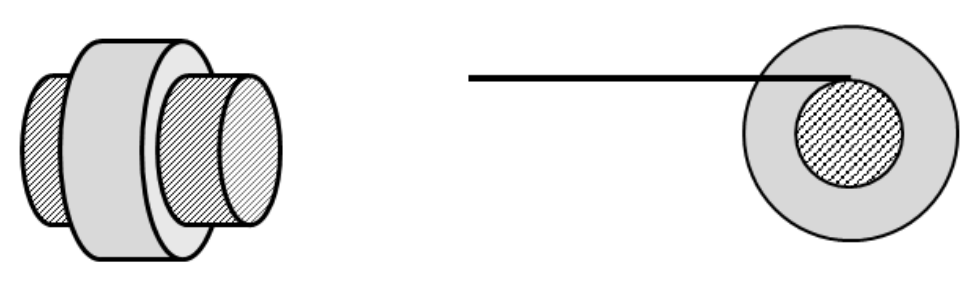
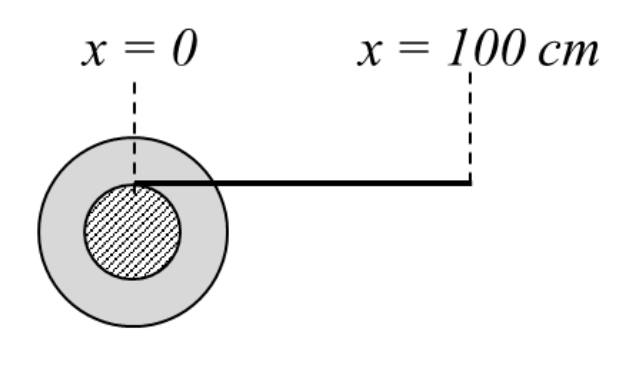
A small roller having a diameter of features an axle with a diameter of (as shown in the left figure). It rests on a flat horizontal floor while a meter scale is placed horizontally atop its axle (as shown in the right figure). The scale is pushed gradually over the axle such that it moves without slipping relative to the axle, causing the roller to roll without slipping on the ground. After the roller travels a distance of , which of the following diagrams correctly represents the final position of the scale? (Schematics are not to scale)
Options
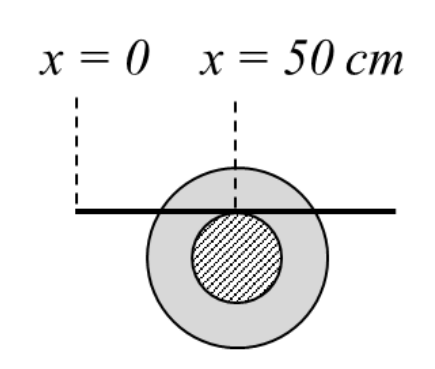
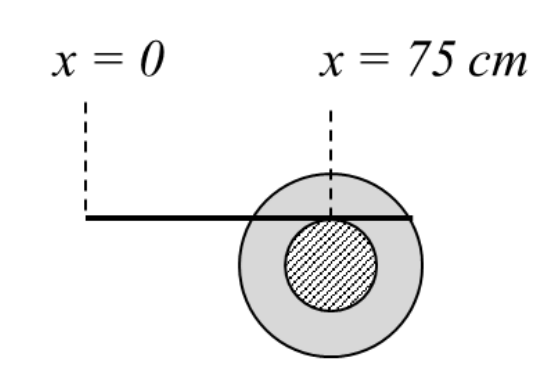
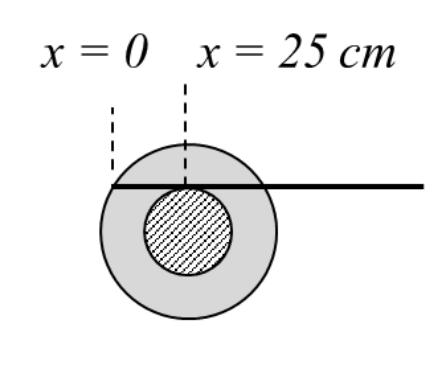
Topics & Concepts
Step-by-Step Solution
To determine the final position of the meter scale, we analyze the rolling motion of the cylinder and the relative motion of the scale resting on its axle.
1. System Parameters
- Radius of the outer cylinder (roller):
- Radius of the inner axle:
- Total length of the scale:
2. Kinematics of Pure Rolling Motion
Let be the forward velocity of the center of mass of the roller. Since the outer cylinder rolls without slipping on the horizontal ground, its angular velocity is related to by:
The top point of the axle, where the meter scale makes contact, moves forward with a linear velocity given by:
Substituting the given values of and :
3. Displacement Calculations
Integrating the velocities with respect to time gives the relationship between the displacement of the scale () and the displacement of the roller's center ():
Given that the roller moves a distance of :
The displacement of the scale relative to the axle is:
4. Final Position on the Scale
Initially, the right edge of the meter scale (at ) rests on top of the axle, and the rest of the scale (towards ) extends to the left.
Since the scale moves to the right relative to the axle by , the contact point on the scale shifts towards the left end (towards ) by .
Thus, the mark on the scale directly above the axle after the motion is:
This matches the diagram shown in Option (B).
Correct Option: (B)