Motion of Aluminum Disc Under Rotating External Magnetic Field
A lightweight disc made of aluminum (which is nonmagnetic) is mounted horizontally and can freely rotate about its central axis. A strong bar magnet is positioned vertically above the disc, displaced from the axis of rotation. When the magnet is revolved around the central axis of the disc, what will happen to the disc? (The diagram is schematic and not drawn to scale)
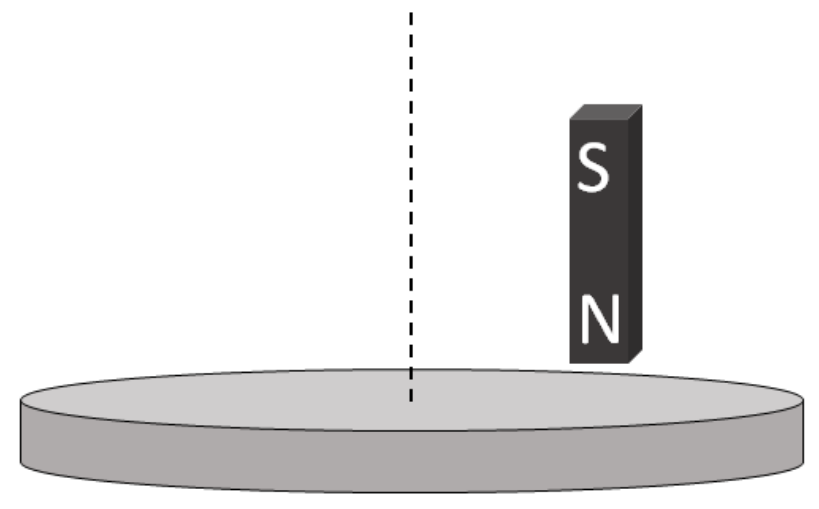
Options
rotate in the direction opposite to the direction of magnet's motion
rotate in the same direction as the direction of magnet's motion
not rotate and its temperature will remain unchanged
not rotate but its temperature will slowly rise
Topics & Concepts
Step-by-Step Solution
To determine the motion of the aluminium disc when the strong bar magnet is revolved around its central axis, we analyze the system using Faraday's Law of Electromagnetic Induction and Lenz's Law.
1. Induction of Eddy Currents
Aluminium is a non-magnetic material (paramagnetic/diamagnetic with negligible magnetic susceptibility), but it is an excellent electrical conductor.
As the bar magnet revolves above the disc with an angular velocity , the localized magnetic flux through any given region of the disc continuously changes with time:
According to Faraday's Law of Electromagnetic Induction, an electromotive force (emf) is induced in the conducting disc:
This induced emf gives rise to circulating electrical currents within the bulk of the aluminium disc, known as eddy currents.
2. Application of Lenz's Law
According to Lenz's Law, the direction of the induced eddy currents will always oppose the cause that produces them.
- The cause of the induced current is the relative rotational motion between the revolving magnet and the disc.
- Let the angular velocity of the magnet be and that of the disc be . The relative angular velocity of the magnet with respect to the disc is:
To oppose this relative motion and reduce , the magnetic force acting on the induced eddy currents creates a magnetic torque on the disc that acts in the direction of .
3. Direction of Torque and Motion
The magnetic force on the eddy currents produces a drag effect (electromagnetic drag) that pulls the disc along with the moving magnetic field.
Consequently, the net torque on the disc is in the same direction as the revolution of the magnet:
Thus, the disc will accelerate and rotate in the same direction as the direction of the magnet's motion (a physical manifestation known as Arago's rotation, which is the foundational principle of induction motors).
Conclusion
The disc will rotate in the same direction as the direction of the magnet's motion.
Correct Option: (B)