Polarization and Refraction of Blue and Red Light in Prism
A plane polarized blue light ray is incident on a prism such that there is no reflection from the surface of the prism. The angle of deviation of the emergent ray is (see Figure-1). The angle of minimum deviation for red light from the same prism is (see Figure-2). The refractive index of the prism material for blue light is . Which of the following statement(s) is(are) correct?
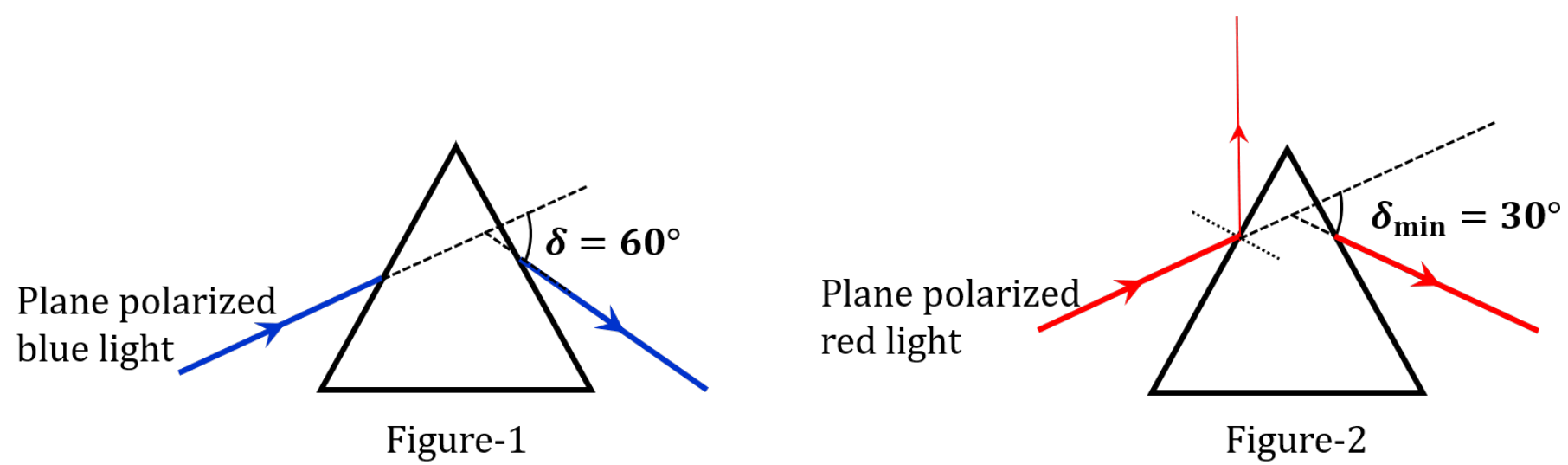
Options
The blue light is polarized in the plane of incidence.
The angle of the prism is .
The refractive index of the material of the prism for red light is .
The angle of refraction for blue light in air at the exit plane of the prism is .
Step-by-Step Solution
To find the correct statement(s), let us analyze each concept and condition step by step:
1. Brewster's Angle and Polarization (Option A)
When light is incident on an interface at Brewster's angle, the reflected ray is completely polarized perpendicular to the plane of incidence (s-polarized). If the incident light is plane-polarized in the plane of incidence (p-polarized), there is zero reflection at the interface, and the light is completely transmitted into the medium.
Given that there is no reflection at the first surface of the prism:
- The blue light must be incident at Brewster's angle .
- The blue light must be polarized in the plane of incidence.
Therefore, Option (A) is correct.
2. Angle of Incidence and Prism Angle (Options B and D)
For the blue light:
-
Brewster's Angle of Incidence:
-
Angle of Refraction at the First Surface (): Using Snell's law at the first surface:
-
Relation between Deviation, Prism Angle, and Emergence: The deviation of a ray passing through a prism is given by: Given and :
-
Refraction at the Second Surface: The angle of incidence at the second surface inside the prism is: Applying Snell's law at the exit surface: Substituting and :
- The angle of the prism is , which makes Option (B) incorrect.
- The angle of refraction for blue light in air at the exit plane is the angle of emergence: Therefore, Option (D) is correct.
3. Refractive Index for Red Light (Option C)
For red light, the angle of minimum deviation is given as , and the prism angle is .
Using the prism formula for minimum deviation:
Therefore, Option (C) is correct.
Conclusion:
The correct statements are (A), (C), and (D).