Motion of Ball on Curved Slide Bouncing off Ground
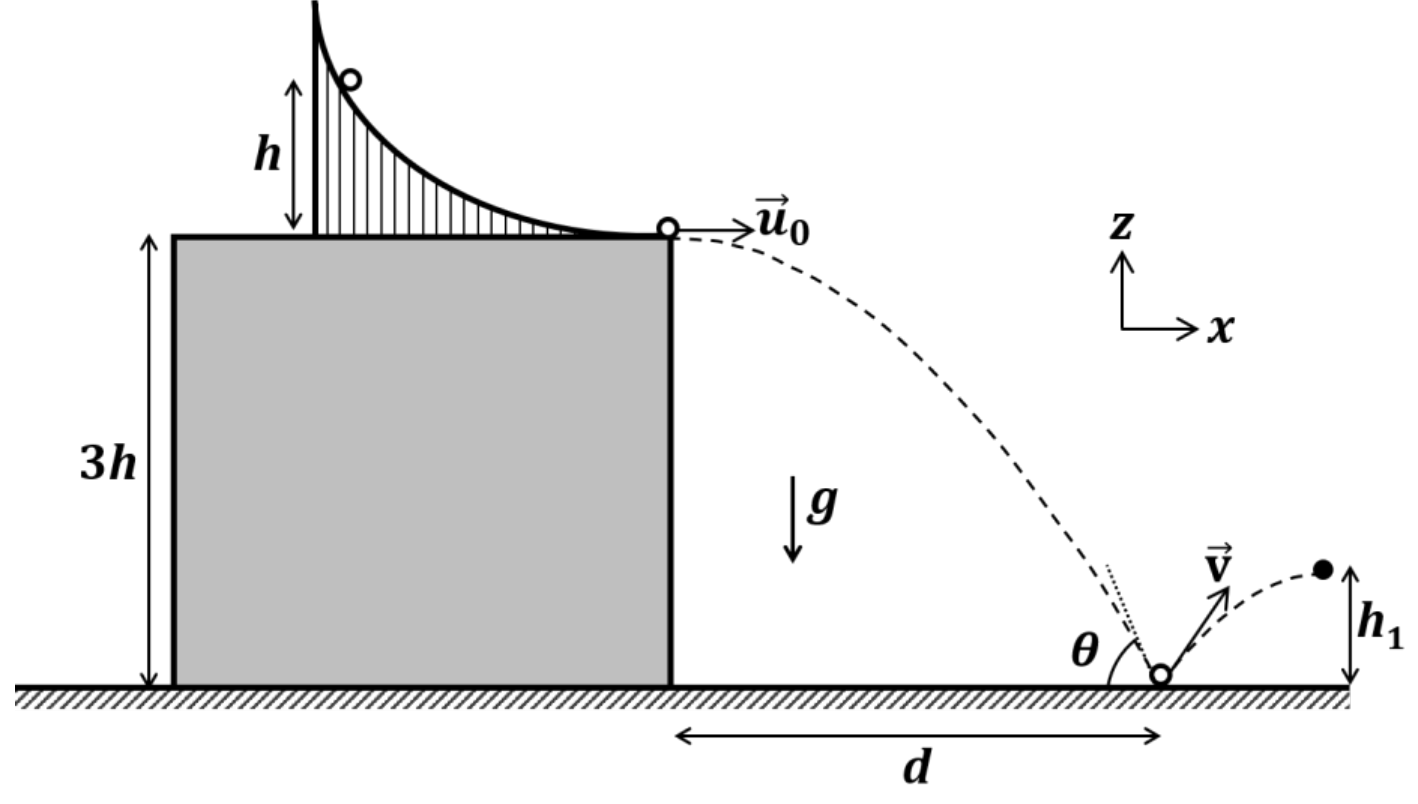
A slide with a frictionless curved surface, which becomes horizontal at its lower end, is fixed on the terrace of a building of height from the ground, as shown in the figure. A spherical ball of mass is released on the slide from rest at a height from the top of the terrace. The ball leaves the slide with a velocity and falls on the ground at a distance from the building making an angle with the horizontal. It bounces off with a velocity and reaches a maximum height . The acceleration due to gravity is and the coefficient of restitution of the ground is . Which of the following statement(s) is(are) correct?
Options
Topics & Concepts
Step-by-Step Solution
To determine which of the given statements are correct, we analyze the motion of the ball in different stages:
1. Motion on the frictionless curved slide:
The ball is released from rest at a height from the top of the terrace. Applying the conservation of mechanical energy: Since the slide becomes horizontal at the exit, the initial velocity vector as it leaves the terrace is: Thus, Option (A) is correct.
2. Projectile motion before hitting the ground:
The height of the building is .
- Vertical motion under gravity ():
- Horizontal distance traveled before hitting the ground:
- Components of velocity just before striking the ground:
The angle made with the horizontal is given by: Thus, Option (C) is correct.
3. Bouncing off the ground:
The coefficient of restitution is .
- Horizontal component of velocity remains unchanged:
- Vertical component of velocity after the bounce:
Hence, the velocity vector after bouncing is: Option (B) states , which is incorrect because the rebound velocity is in the direction. Thus, Option (B) is incorrect.
4. Maximum height and the ratio :
The maximum height reached after the bounce is:
Now, calculating the ratio : Thus, Option (D) is correct.
Conclusion:
The correct statements are A, C, and D.