Parallel Inductors Connected to Constant Voltage Source
A constant DC voltage source is linked to a resistor along with two ideal inductors and via a switch , as depicted in the circuit diagram. Mutual inductance between the inductors is zero. Switch is kept open initially. At time , the switch gets closed and electric current starts flowing. Identify the correct statement(s) among the following options:
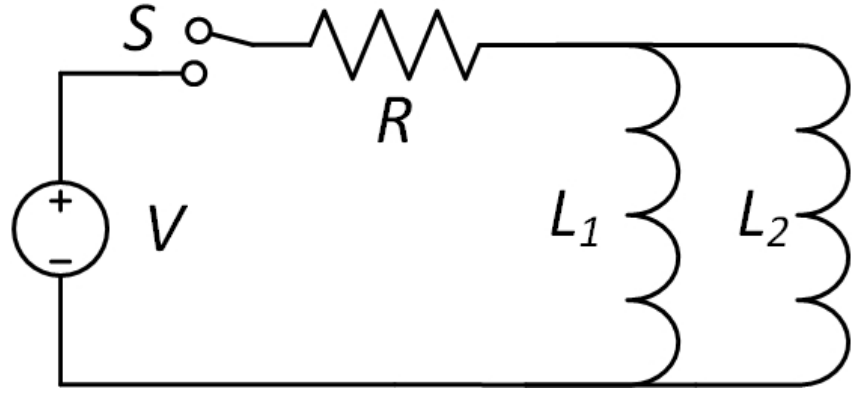
Options
After a sufficiently long duration, the current passing through equals
After a long time interval, current flowing through is equal to
The current ratio through relative to remains constant for all
At instant , current in the resistor equals
Topics & Concepts
Step-by-Step Solution
To determine the correct statements, we analyze the behavior of the given circuit containing a DC voltage source , a resistor , and two ideal inductors and connected in parallel with no mutual inductance ().
1. Relation Between Currents in and for
Let be the current through , be the current through , and be the total current passing through the resistor . By Kirchhoff's Current Law:
Since and are connected in parallel, the potential difference across each inductor at any instant must be equal:
Integrating both sides with respect to time from (at which and because inductors oppose instantaneous changes in current) to any time :
Rearranging this gives the ratio of the currents through and :
This proves that the ratio of the currents through and is independent of time and fixed for all . Hence, Statement C is correct.
2. Current as a Function of Time
From , we can express and in terms of the total current :
Therefore:
The equivalent inductance of two inductors connected in parallel without mutual inductance is given by:
Applying Kirchhoff's Voltage Law around the circuit loop:
Solving this standard first-order linear differential equation with the initial condition :
3. Current at
At :
Since , the current through the resistor at is , not . Hence, Statement D is incorrect.
4. Currents After a Long Time Interval ()
As , the exponential term , giving the steady-state total current through the resistor:
Substituting into the expressions for and :
Hence, Statement A is correct and Statement B is correct.
Conclusion
The correct statements are A, B, and C.