Interference Fringes on Circular Screen with Two Point Sources
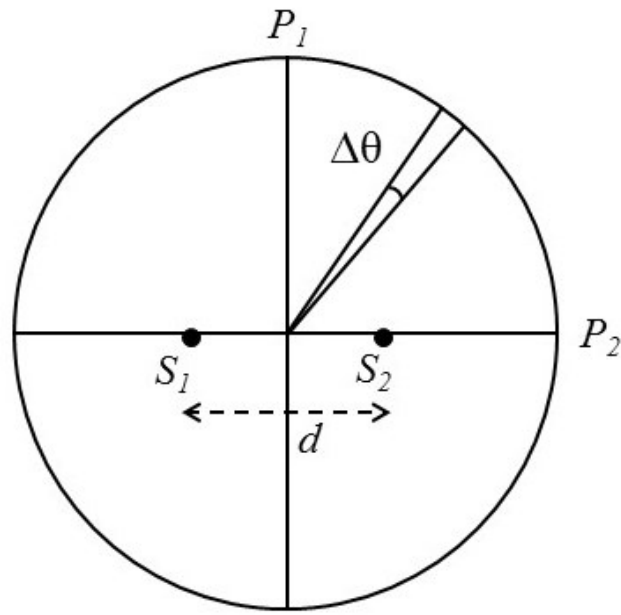
Consider two coherent monochromatic point sources and with wavelength placed symmetrically about the center of a circle. The distance separating the sources is . Interference fringes appear as alternating bright and dark spots along the circle's circumference. Let be the angular separation between two consecutive bright spots. Which of the following options is/are correct?
Options
A dark spot is formed at point
The fringe order reaches its maximum value at
Between and in the first quadrant, the total number of fringes produced is close to 3000
Moving from to along the first quadrant, the angular separation between consecutive bright spots decreases
Topics & Concepts
Step-by-Step Solution
To determine which of the options are correct, let us analyze the path difference and interference pattern formed along the circumference of the circular screen.
1. Geometry and Path Difference
Let the line joining the two coherent sources and be along the horizontal axis (x-axis), with the center of the circle as the origin .
The positions of the sources are given as:
where and the wavelength is .
For any point on the circular screen located at an angle relative to the line (i.e., relative to ):
- At ,
- At ,
Assuming , the path difference between the waves arriving at point from sources and is given by:
2. Analysis of Options
Option A & B: Fringe Order at
At point , the angle is . Therefore, the path difference is maximum:
Let us calculate the order of fringe at :
- Since is an integer, a bright spot (central maximum of order 3000) is formed at point . Thus, Option A is incorrect.
- The fringe order reaches its maximum possible value of at . Thus, Option B is correct.
Option C: Total Number of Fringes between and
- At (), the path difference is , which corresponds to order (a bright spot).
- At (), the path difference corresponds to order .
The bright fringes formed between and in the first quadrant correspond to integers . Hence, the total number of bright fringes produced in the first quadrant is approximately 3000. Thus, Option C is correct.
Option D: Variation of Angular Separation
For a bright spot of order :
Differentiating both sides with respect to :
For two consecutive bright spots, . The magnitude of the angular separation is:
As we move from () to ():
- At , , so is at its minimum value: .
- As decreases from to , decreases, causing the angular separation to increase.
Therefore, the angular separation between consecutive bright spots increases (not decreases) as we move from to . Thus, Option D is incorrect.
Conclusion
The correct options are B and C.