Motion of a Slipping Uniform Rigid Bar on Frictionless Floor
Consider a uniform rigid bar with total length sliding down from its vertical position on a smooth horizontal surface (see figure). At a given moment, the angle formed by the bar with the vertical axis is . Which among the following choices is/are correct regarding its motion?
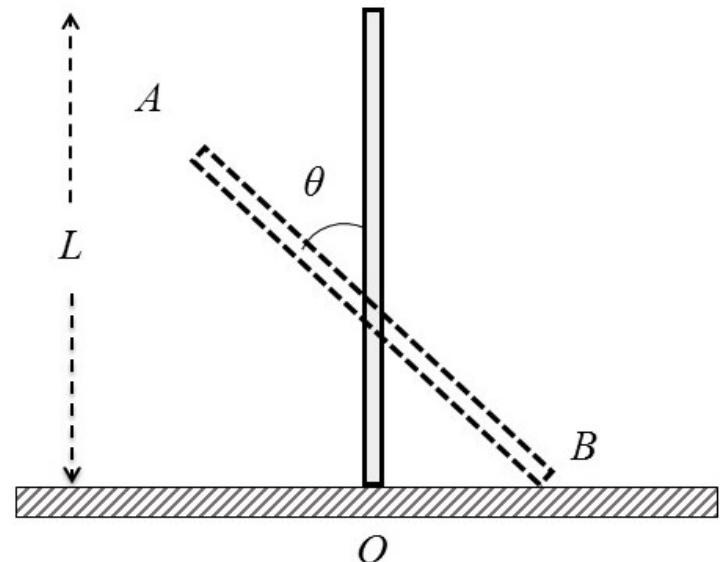
Options
The mid-point of the bar drops in a purely vertical straight line
The path traced by point is parabolic in nature
The instantaneous magnitude of torque about the contact point on the floor varies proportionally with
When the bar subtends an angle with the vertical line, the midpoint's displacement from its starting position is proportional to
Topics & Concepts
Step-by-Step Solution
To determine the correct options, let us analyze the motion of the uniform rigid bar of mass and length .
1. Motion of the Midpoint (Center of Mass)
Let the horizontal floor lie along the -axis, and let the vertical line passing through the initial position of the bar be the -axis. The origin is chosen at the base of the initial vertical line.
- The only external forces acting on the bar are:
- Gravity acting vertically downward at its center of mass (the midpoint ).
- Normal reaction force from the smooth horizontal floor acting vertically upward at the contact point .
Since there is no force in the horizontal direction, . Since the bar starts from rest, the acceleration of the center of mass in the horizontal direction is . Consequently, the -coordinate of the midpoint remains constant at .
Therefore, the midpoint of the bar falls purely vertically downward. Thus, Option [A] is correct.
2. Displacement of the Midpoint
Initially, when the bar is completely vertical (), the position of the midpoint is:
When the bar makes an angle with the vertical axis, the vertical coordinate of the midpoint becomes:
The magnitude of the displacement of the midpoint from its initial position is:
Thus, the displacement of the midpoint is directly proportional to . Therefore, Option [D] is correct.
3. Trajectory of Point
Since , the coordinates of the top end at any instant when the bar subtends an angle with the vertical are given by:
Eliminating using :
This is the equation of an ellipse, not a parabola. Therefore, Option [B] is incorrect.
4. Instantaneous Torque About the Contact Point
Let be the point of contact with the floor. The position of relative to along the horizontal direction is at a distance of .
Taking torque about the contact point :
- The normal force passes through point , so its torque about is zero.
- The torque is due solely to the gravitational force acting at the center of mass :
Thus, the instantaneous magnitude of torque about the contact point on the floor is proportional to . Therefore, Option [C] is correct.
Conclusion
The correct statements are A, C, and D.