Oscillation Frequency of Charged Mass Attached to Spring with Dipole Interaction
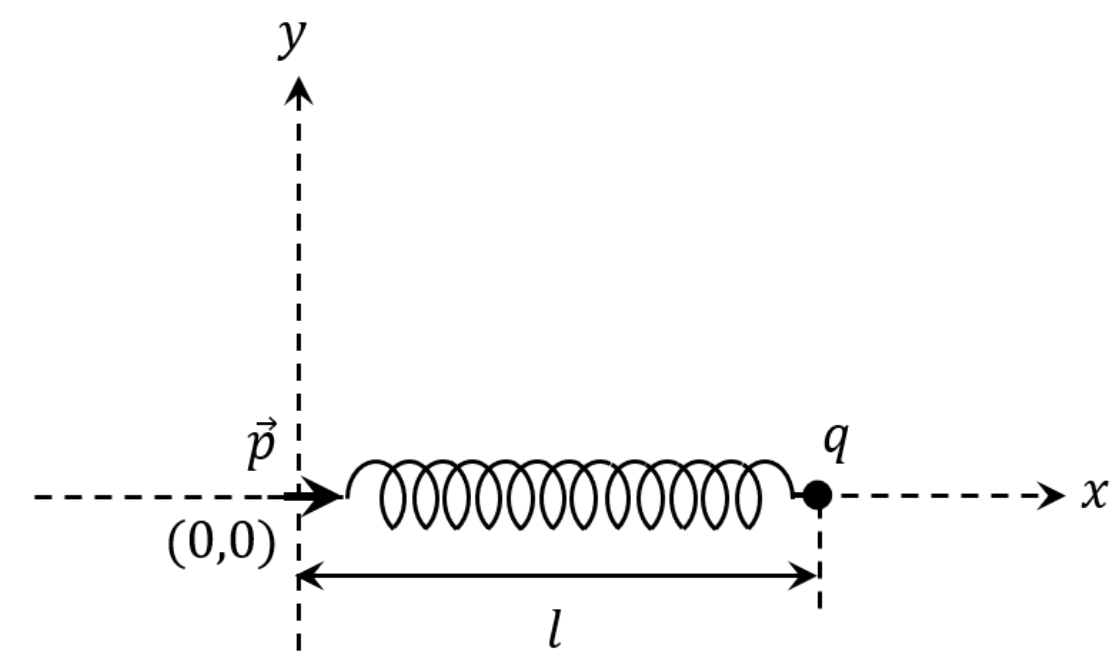
Suppose one end of a spring having negligible unstretched length and spring constant is anchored at the origin . A small particle of mass with positive charge is connected to the other end. This setup rests on a smooth horizontal plane. When a point dipole directed towards charge is placed fixed at the origin, the spring extends to a length , coming to a new equilibrium state (as shown in figure). If the mass is slightly perturbed by along its equilibrium line and released, its oscillation frequency is found as . Determine the value of .
Topics & Concepts
Step-by-Step Solution
To find the frequency of oscillation of the particle, we analyze the forces acting on the particle at its equilibrium position and when it is slightly displaced from it.
1. Equilibrium Position
Let the origin be the position of the fixed point dipole and the fixed end of the spring. The particle of mass and positive charge is at a distance along the positive x-axis.
The electric field at position along the axial line of the dipole is:
The electrostatic force acting on the charge is directed away from the origin (along ):
Since the spring has negligible unstretched length, the spring force acts towards the origin (along ):
At the equilibrium position , the net force on the particle is zero:
2. Perturbation and Equation of Motion
Let the particle be displaced slightly by a distance along the line of equilibrium such that its new position is , where .
The net restoring force acting on the particle at this new position is:
Using binomial approximation for :
Substituting this back into the net force equation:
Using relation , we substitute :
3. Calculation of Oscillation Frequency
The net restoring force is proportional to the displacement , demonstrating simple harmonic motion:
The angular frequency of oscillation is:
The frequency of oscillation is given by:
Comparing this with the given expression , we get: