Maximum Height of Water Above Glass Rim Due to Surface Tension
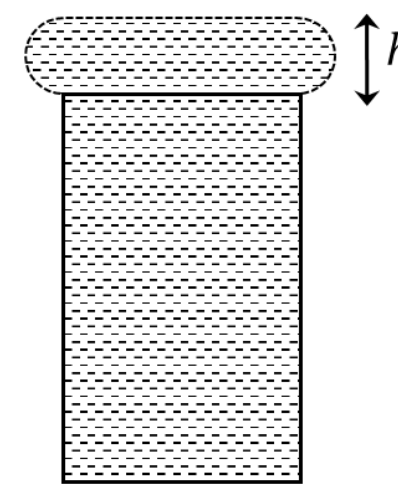
When a glass is filled carefully with water, it can hold water up to a height above its rim owing to surface tension. To determine just before the water begins to overflow, model the water region above the rim as a disc of thickness possessing semicircular edges as depicted schematically in the figure. When the water pressure at the bottom of this disc exceeds what can be supported by surface tension, the water surface breaks near the rim and starts to flow out. Given the density of water as , its surface tension as , and the gravitational acceleration as , calculate the value of (in ).
Topics & Concepts
Step-by-Step Solution
To find the maximum height of the water above the glass rim just before overflowing, we can analyze the problem using two standard approaches: Pressure Balance Method (based on the problem statement's text) and Force Balance Method (based on horizontal force equilibrium).
Approach 1: Pressure Balance Method
-
Hydrostatic Pressure at the Rim: The height of the water region above the glass rim is . The excess hydrostatic pressure at the bottom of this region (at the rim level) relative to atmospheric pressure is:
-
Excess Pressure Supported by Surface Tension: The edge of the water disc is modeled as a cylindrical surface with a semicircular vertical profile of diameter . Thus, the radius of curvature of the surface is:
The maximum excess pressure that can be supported by surface tension for a cylindrical surface of radius is given by the Young-Laplace equation:
-
Condition for Overflow: Just before the water starts to overflow, the hydrostatic pressure at the bottom equals the maximum pressure supported by surface tension:
-
Calculation: Given values:
- Density of water,
- Surface tension,
- Acceleration due to gravity,
Substituting these values into the expression:
Approach 2: Force Balance Method
-
Hydrostatic Force: Consider a segment of length along the rim. The outward horizontal force on this segment due to the gauge hydrostatic pressure is:
-
Surface Tension Force: The inward horizontal force holding the liquid surface intact is exerted by surface tension at both the top and bottom boundaries of the semicircular edge:
-
Equilibrium Condition: Equating the outward hydrostatic force to the inward surface tension force:
-
Calculation:
Final Answer:
Depending on the interpretation, the value of is:
- (via Pressure Balance at the bottom)
- (via Horizontal Force Balance)