Organic Compounds Remaining After Halogenation Reactions of Acetone
After completion of the reactions ( and ), identify the organic compound(s) present in the reaction mixtures:
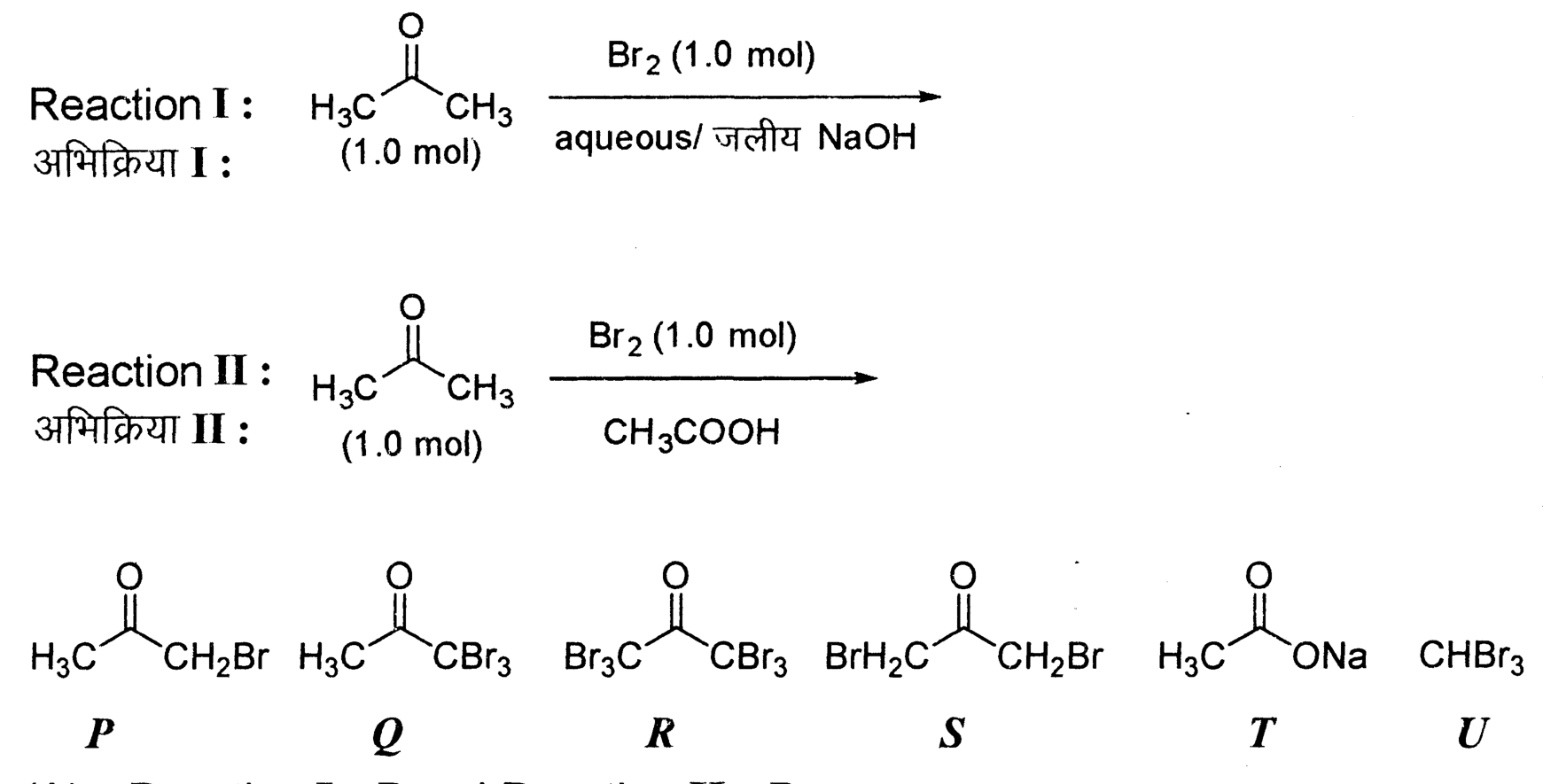
Options
Reaction : and Reaction :
Reaction : , acetone and Reaction : , acetone
Reaction : , acetone and Reaction :
Reaction : , acetone and Reaction : , acetone
Topics & Concepts
Step-by-Step Solution
To determine the organic compounds present in the reaction mixtures after completion, we analyze the mechanisms and stoichiometry of both halogenation reactions of acetone ().
1. Analysis of Reaction I (Base-Catalyzed Halogenation):
-
Mechanism: Under basic conditions, halogenation occurs via the enolate intermediate. After the substitution of one hydrogen atom by a halogen atom, the electron-withdrawing nature of the bromine atom increases the acidity of the remaining -hydrogens on the same carbon. Consequently, subsequent bromination steps occur much faster than the initial step, rapidly forming tribromoacetone ().
The intermediate then undergoes a haloform cleavage by hydroxide ion () to yield sodium acetate (, compound ) and bromoform (, compound ).
-
Stoichiometry: The complete stoichiometry of the haloform reaction is:
Here, of are required to completely react with of acetone.
Since only of is provided for of acetone:
-
Organic products/compounds present in Reaction I:
2. Analysis of Reaction II (Acid-Catalyzed Halogenation):
-
Mechanism: Under acidic conditions (), bromination proceeds via the enol mechanism. Monobromination forms bromoacetone (, compound ).
The presence of the electronegative bromine atom in bromoacetone destabilizes the protonated carbonyl intermediate (), suppressing further enolization. Thus, acid-catalyzed halogenation stops cleanly after monobromination.
-
Stoichiometry:
Both reactants are present in a molar ratio, leading to complete consumption of both acetone and .
-
Organic products/compounds present in Reaction II:
Conclusion:
- Reaction I: , acetone
- Reaction II:
This corresponds to Option C.