Electrophilic Bromination and Ipsosubstitution of Phenolsulfonic Acid
Identify the major product(s) formed in the given chemical transformation:
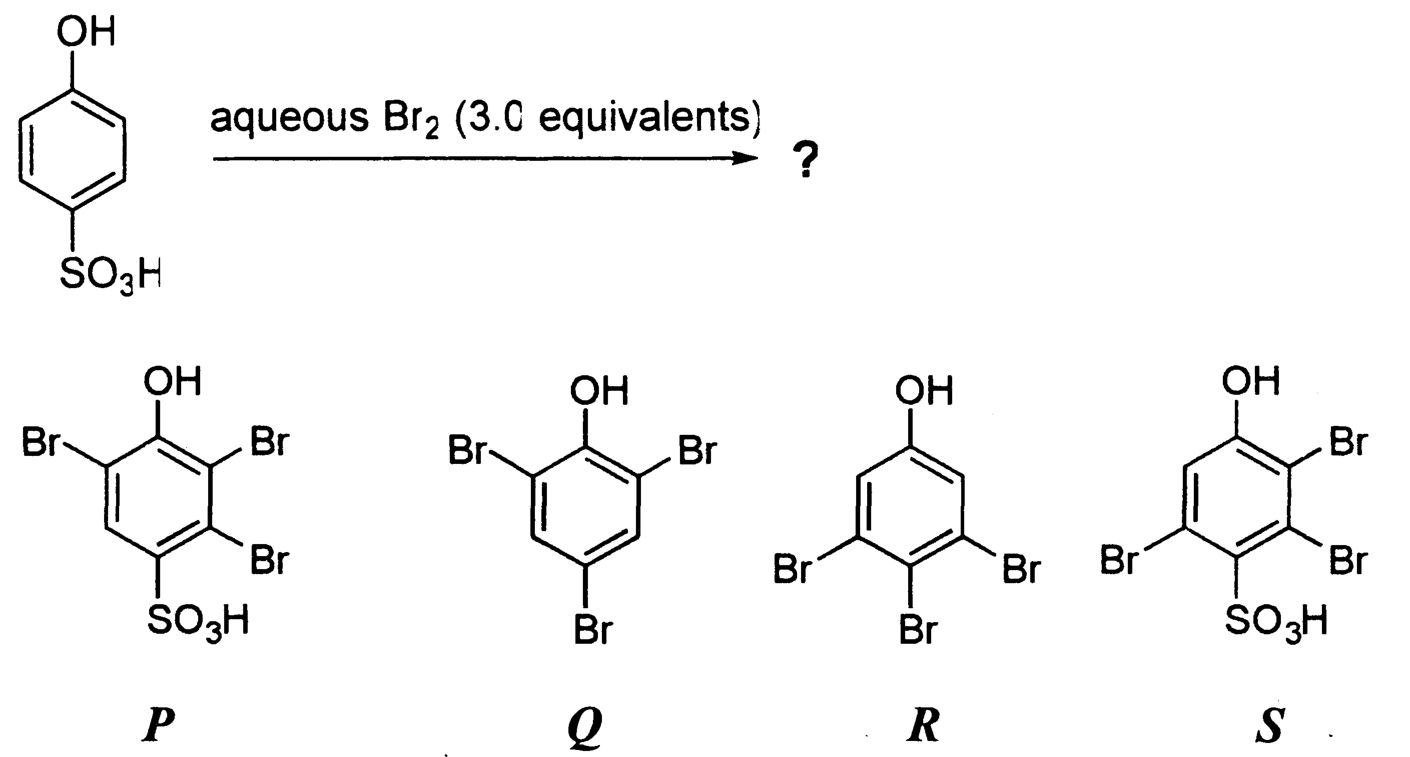
Options
Step-by-Step Solution
To determine the major product of the given reaction, we analyze the reaction step-by-step using the principles of electrophilic aromatic substitution (EAS) and ipso-substitution:
-
Activation and Directing Influence of the Group: In 4-hydroxybenzenesulfonic acid, the hydroxyl group () is a strong ortho/para-directing activating group. In an aqueous medium, hydrogen bonding and partial ionization enhance the electron density of the aromatic ring significantly, particularly at the positions ortho and para to the group (positions 2, 4, and 6).
-
Electrophilic Bromination at Ortho-Positions: The ortho-positions (positions 2 and 6 relative to ) are vacant and highly nucleophilic. The first two equivalents of aqueous bromine () undergo electrophilic aromatic substitution at these positions: This yields 3,5-dibromo-4-hydroxybenzenesulfonic acid (or 2,6-dibromo-4-sulfophenol).
-
Ipso-Substitution (Desulfonation): The sulfonic acid group () at position 4 (para to ) acts as a good leaving group during electrophilic substitution. In aqueous bromine, the third equivalent of attacks the C-4 position occupied by the group (ipso-attack).
The loss of the group as sulfuric acid () restores aromaticity, resulting in ipso-bromination:
-
Product Identification: The resulting molecule is 2,4,6-tribromophenol, which corresponds to compound .
Thus, the correct option is (B).