Identification of Thermal Operations in a Cyclic Thermodynamic Process
A fixed mass '' of a gas undergoes a series of cyclic state transformations from state to to to and returns back to as depicted in the Pressure-Volume plot below.
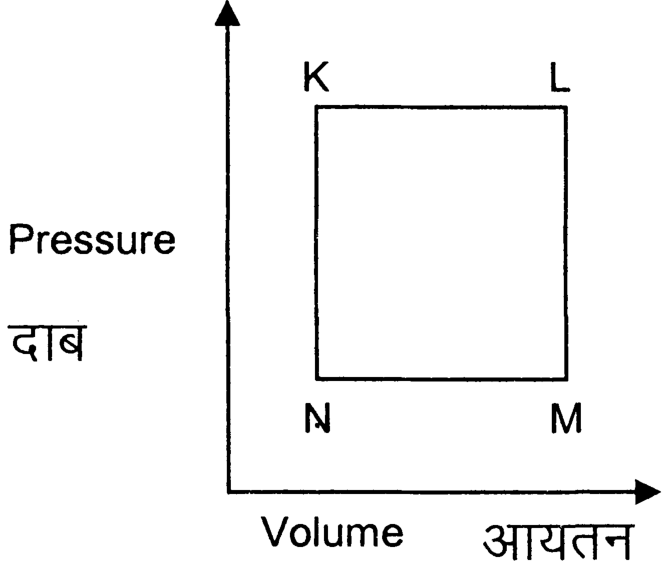
Identify the sequential operations that allow this complete cycle of state transformations:
Options
Heating, cooling, heating, cooling
Cooling, heating, cooling, heating
Heating, cooling, cooling, heating
Cooling, heating, heating, cooling
Topics & Concepts
Step-by-Step Solution
To determine the sequence of thermal operations (heating or cooling) for the complete cycle of state transformations , we analyze the temperature change for each process using the ideal gas equation of state:
Let the coordinates in the diagram be:
- State :
- State :
- State :
- State :
where and .
-
Process (Isobaric Expansion):
- The pressure remains constant at , while the volume increases from to ().
- The temperature changes from to .
- Since , the temperature increases. Thus, this step requires Heating.
-
Process (Isochoric Depressurization):
- The volume remains constant at , while the pressure decreases from to ().
- The temperature changes from to .
- Since , the temperature decreases. Thus, this step requires Cooling.
-
Process (Isobaric Compression):
- The pressure remains constant at , while the volume decreases from to ().
- The temperature changes from to .
- Since , the temperature decreases. Thus, this step requires Cooling.
-
Process (Isochoric Pressurization):
- The volume remains constant at , while the pressure increases from to ().
- The temperature changes from to .
- Since , the temperature increases. Thus, this step requires Heating.
Therefore, the sequential operations enabling this transformation are Heating, cooling, cooling, heating.
Correct Option: C