JEE Challenger
More from Ray Optics and Optical Instruments

Numerical Aperture Comparison for Submerged Optical Fibers

Comprehension Passage

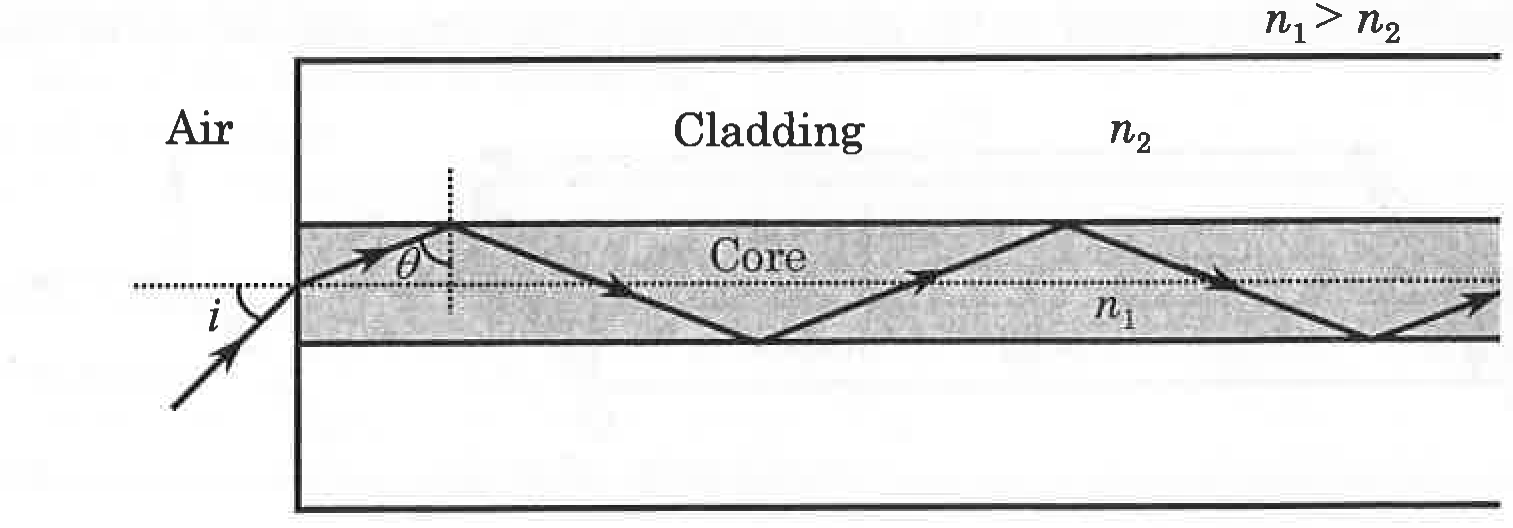
Light guidance in an optical fiber can be understood by considering a structure comprising of thin solid glass cylinder of refractive index n1n_1 surrounded by a medium of lower refractive index n2n_2. The light guidance in the structure takes place due to successive total internal reflections at the interface of the media n1n_1 and n2n_2 as shown in the figure. All rays with the angle of incidence ii less than a particular value imi_m are confined in the medium of refractive index n1n_1. The numerical aperture (NA) of the structure is defined as sin⁡im\sin i_m.

Passage Diagram 1

Consider two structures namely S1S_1 with n1=45/4n_1 = \sqrt{45}/4 and n2=3/2n_2 = 3/2, and S2S_2 with n1=8/5n_1 = 8/5 and n2=7/5n_2 = 7/5. Taking the refractive index of water as 4/34/3 and that of air as 11, select the correct option(s):

Options

A

NA of S1S_1 immersed in water is identical to that of S2S_2 immersed in a liquid having refractive index 16315\frac{16}{3\sqrt{15}}

Correct
B

NA of S1S_1 immersed in a liquid of refractive index 615\frac{6}{\sqrt{15}} is identical to that of S2S_2 immersed in water

C

NA of S1S_1 placed in air is identical to that of S2S_2 immersed in a liquid of refractive index 415\frac{4}{\sqrt{15}}

Correct
D

NA of S1S_1 placed in air is identical to that of S2S_2 placed in water

Step-by-Step Solution

To determine the Numerical Aperture (NA\text{NA}) of an optical fiber submerged in a medium of refractive index n0n_0, we analyze the path of light at the entrance face and at the core-cladding interface.

Let imi_m be the maximum angle of incidence in the external medium n0n_0 such that the ray undergoes Total Internal Reflection (TIR) at the core-cladding interface.

  1. At the entrance face (external medium n0n_0 to core n1n_1): By Snell's Law: n0sin⁡im=n1sin⁡(90∘−θc)=n1cos⁡θcn_0 \sin i_m = n_1 \sin(90^\circ - \theta_c) = n_1 \cos \theta_c where θc\theta_c is the critical angle at the core-cladding interface.

  2. At the core-cladding interface (core n1n_1 to cladding n2n_2): For TIR to just occur at the critical angle θc\theta_c: sin⁡θc=n2n1\sin \theta_c = \frac{n_2}{n_1}

Using the trigonometric identity cos⁡θc=1−sin⁡2θc\cos \theta_c = \sqrt{1 - \sin^2 \theta_c}: cos⁡θc=1−(n2n1)2=n12−n22n1\cos \theta_c = \sqrt{1 - \left(\frac{n_2}{n_1}\right)^2} = \frac{\sqrt{n_1^2 - n_2^2}}{n_1}

  1. Numerical Aperture (NA\text{NA}): Substituting cos⁡θc\cos \theta_c back into Snell's Law equation: n0sin⁡im=n1(n12−n22n1)=n12−n22n_0 \sin i_m = n_1 \left( \frac{\sqrt{n_1^2 - n_2^2}}{n_1} \right) = \sqrt{n_1^2 - n_2^2}

Therefore, the Numerical Aperture of the fiber structure in a medium of refractive index n0n_0 is defined as: NA=sin⁡im=n12−n22n0\text{NA} = \sin i_m = \frac{\sqrt{n_1^2 - n_2^2}}{n_0}


Calculations for Structures S1S_1 and S2S_2:

For Structure S1S_1:

Given n1=454n_1 = \frac{\sqrt{45}}{4} and n2=32n_2 = \frac{3}{2}: n12−n22=4516−94=45−3616=916=34\sqrt{n_1^2 - n_2^2} = \sqrt{\frac{45}{16} - \frac{9}{4}} = \sqrt{\frac{45 - 36}{16}} = \sqrt{\frac{9}{16}} = \frac{3}{4}

Thus, for S1S_1 in a medium of refractive index n0,1n_{0,1}: NA(S1)=34n0,1\text{NA}(S_1) = \frac{3}{4 n_{0,1}}

For Structure S2S_2:

Given n1=85n_1 = \frac{8}{5} and n2=75n_2 = \frac{7}{5}: n12−n22=6425−4925=1525=155\sqrt{n_1^2 - n_2^2} = \sqrt{\frac{64}{25} - \frac{49}{25}} = \sqrt{\frac{15}{25}} = \frac{\sqrt{15}}{5}

Thus, for S2S_2 in a medium of refractive index n0,2n_{0,2}: NA(S2)=155n0,2\text{NA}(S_2) = \frac{\sqrt{15}}{5 n_{0,2}}


Evaluating the Options:

  • Option A:

    • S1S_1 immersed in water (n0,1=4/3n_{0,1} = 4/3): NA(S1,water)=34×(43)=916\text{NA}(S_1, \text{water}) = \frac{3}{4 \times \left(\frac{4}{3}\right)} = \frac{9}{16}
    • S2S_2 immersed in liquid with refractive index n0,2=16315n_{0,2} = \frac{16}{3\sqrt{15}}: NA(S2)=155×(16315)=3×155×16=4580=916\text{NA}(S_2) = \frac{\sqrt{15}}{5 \times \left(\frac{16}{3\sqrt{15}}\right)} = \frac{3 \times 15}{5 \times 16} = \frac{45}{80} = \frac{9}{16} Since NA(S1,water)=NA(S2)\text{NA}(S_1, \text{water}) = \text{NA}(S_2), Option A is correct.
  • Option B:

    • S1S_1 immersed in liquid of refractive index n0,1=615n_{0,1} = \frac{6}{\sqrt{15}}: NA(S1)=34×(615)=158\text{NA}(S_1) = \frac{3}{4 \times \left(\frac{6}{\sqrt{15}}\right)} = \frac{\sqrt{15}}{8}
    • S2S_2 immersed in water (n0,2=4/3n_{0,2} = 4/3): NA(S2,water)=155×(43)=31520\text{NA}(S_2, \text{water}) = \frac{\sqrt{15}}{5 \times \left(\frac{4}{3}\right)} = \frac{3\sqrt{15}}{20} Since 158≠31520\frac{\sqrt{15}}{8} \neq \frac{3\sqrt{15}}{20}, Option B is incorrect.
  • Option C:

    • S1S_1 placed in air (n0,1=1n_{0,1} = 1): NA(S1,air)=34×1=34\text{NA}(S_1, \text{air}) = \frac{3}{4 \times 1} = \frac{3}{4}
    • S2S_2 immersed in liquid with refractive index n0,2=415n_{0,2} = \frac{4}{\sqrt{15}}: NA(S2)=155×(415)=1520=34\text{NA}(S_2) = \frac{\sqrt{15}}{5 \times \left(\frac{4}{\sqrt{15}}\right)} = \frac{15}{20} = \frac{3}{4} Since NA(S1,air)=NA(S2)\text{NA}(S_1, \text{air}) = \text{NA}(S_2), Option C is correct.
  • Option D:

    • NA(S1,air)=34=0.75\text{NA}(S_1, \text{air}) = \frac{3}{4} = 0.75
    • NA(S2,water)=31520≈0.581\text{NA}(S_2, \text{water}) = \frac{3\sqrt{15}}{20} \approx 0.581 Since they are not equal, Option D is incorrect.

Conclusion:

The correct options are A and C.