Net External Force on Disk in Rolling Spring System
A uniform thin cylindrical disk of mass and radius is attached to two identical massless springs of spring constant which are fixed to the wall as shown in the figure. The springs are attached to the axle of the disk symmetrically on either side at a distance from its centre. The axle is massless and both the springs and the axle are in a horizontal plane. The unstretched length of each spring is . The disk is initially at its equilibrium position with its centre of mass (CM) at a distance from the wall. The disk rolls without slipping with velocity . The coefficient of friction is .
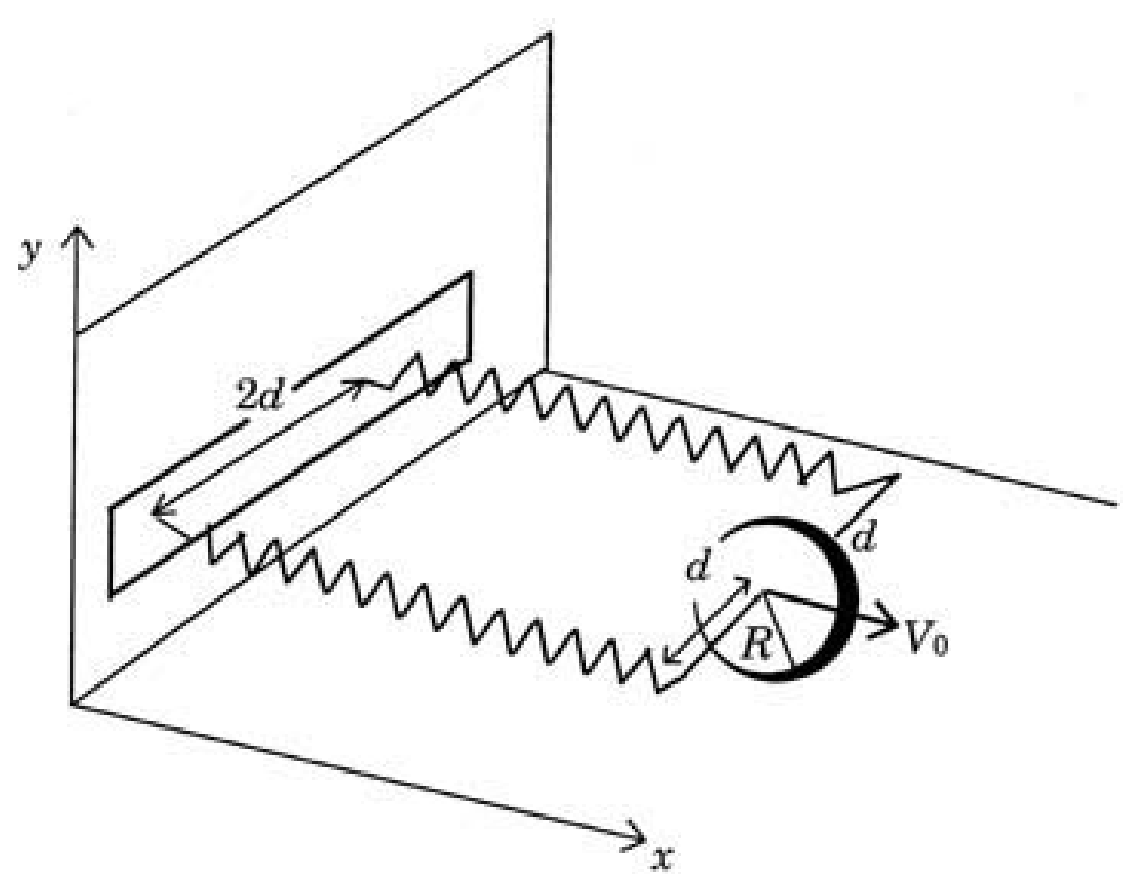
The net external force acting on the disk when its centre of mass is at displacement with respect to its equilibrium position is
Options
Topics & Concepts
Step-by-Step Solution
To find the net external force acting on the disk when its centre of mass is at a displacement from its equilibrium position, we analyze the translational and rotational dynamics of the rolling disk.
1. System Parameters and Kinematics
- Mass of the disk =
- Radius of the disk =
- Moment of inertia of the uniform disk about its center of mass:
- The disk is attached to two identical springs of spring constant connected in parallel. Thus, the effective spring constant is:
- The springs are attached symmetrically to the axle passing through the center of mass (CM). Therefore, the restoring force due to the springs acts through the CM and exerts zero torque about the CM.
Let be the horizontal displacement of the center of mass from its equilibrium position, and be its linear acceleration.
For rolling without slipping on the horizontal surface, the relation between the linear acceleration and angular acceleration about the CM is:
(where a positive displacement and acceleration are directed away from the wall, and counter-clockwise rotation is taken as positive).
2. Equations of Motion
Translational Motion of the CM:
The forces acting on the disk horizontally are the restoring force of the two springs and the static friction force at the contact point with the ground.
Since :
Rotational Motion about the CM:
Taking torque about the center of mass, only the friction force provides a torque:
Using Newton's second law for rotation ():
Substitute and :
3. Solving for the Net External Force
Substitute from Equation 2 into Equation 1:
Rearranging the terms:
Since the net external force acting on the system is :
4. Alternative Verification using Energy Method
The total mechanical energy of the system is the sum of translational kinetic energy, rotational kinetic energy, and potential energy of the springs:
Substituting and :
Since mechanical energy is conserved in pure rolling ():
For :
Thus, the net external force acting on the disk is .
Correct Option: D