Condition for Linear Radial Dependence of Nuclear Electric Field
Paragraph for Question Nos. 36 to 38
The nuclear charge is non-uniformly distributed within a nucleus of radius . The charge density [charge per unit volume] is dependent only on the radial distance from the centre of the nucleus as shown in figure. The electric field is only along the radial direction.
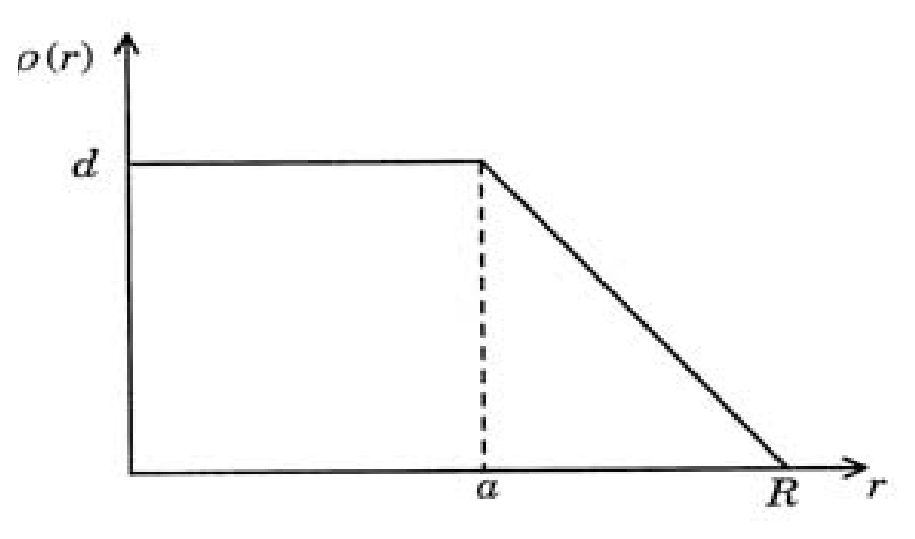
The electric field within the nucleus is generally observed to be linearly dependent on . This implies
Options
Topics & Concepts
Step-by-Step Solution
According to Gauss's law for a spherically symmetric charge distribution, the radial electric field at a distance from the center of the nucleus is related to the enclosed charge by:
The enclosed charge inside a sphere of radius is:
Substituting into the expression for , we get:
For the electric field within the nucleus to be linearly dependent on (i.e., , where is a constant), we have:
Differentiating both sides with respect to :
This demonstrates that a linear radial dependence of the electric field () requires the volume charge density to be uniform throughout the entire volume of the nucleus ().
From the provided graph:
- for
- decreases linearly from to for
For to be constant over the entire region , the parameter must be equal to :
Thus, the correct option is C.