Angular Frequency of SHM for Rolling Disk with Springs
A uniform thin cylindrical disk of mass and radius is attached to two identical massless springs of spring constant which are fixed to the wall as shown in the figure. The springs are attached to the axle of the disk symmetrically on either side at a distance from its centre. The axle is massless and both the springs and the axle are in a horizontal plane. The unstretched length of each spring is . The disk is initially at its equilibrium position with its centre of mass (CM) at a distance from the wall. The disk rolls without slipping with velocity . The coefficient of friction is .
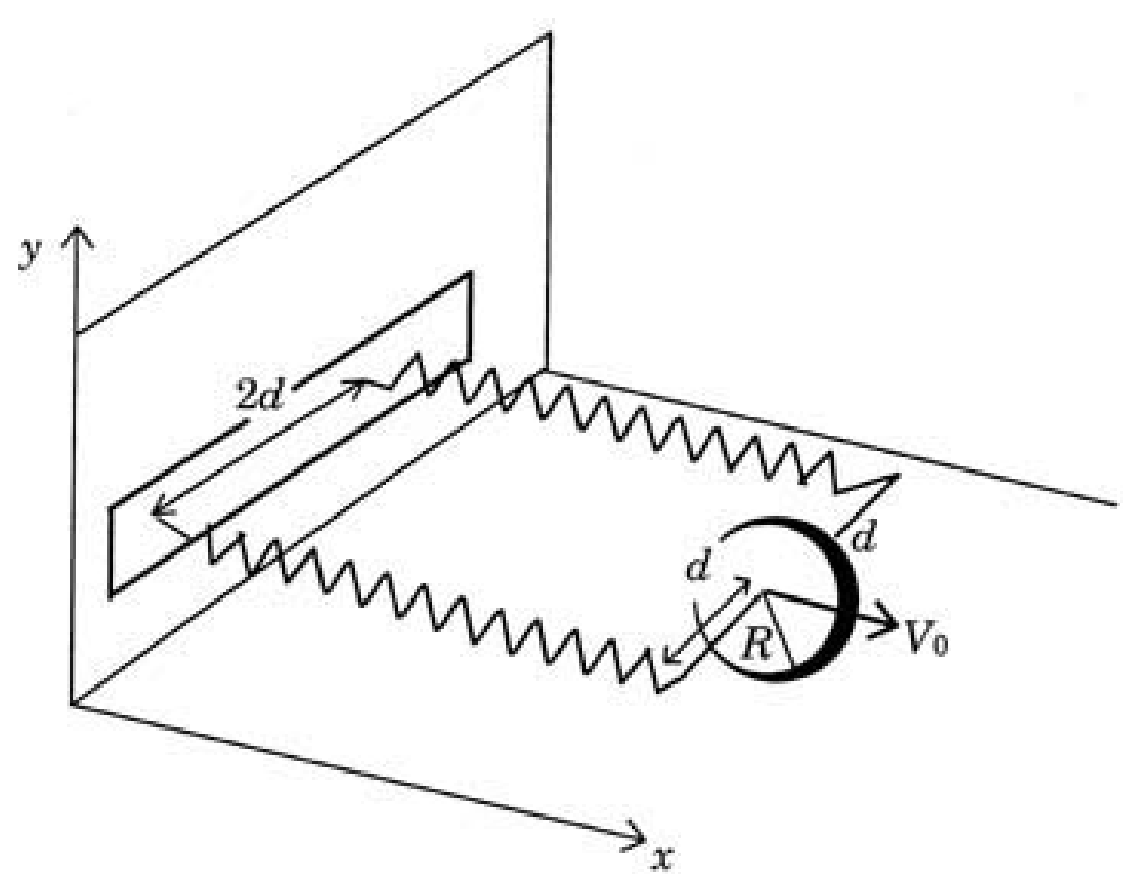
The centre of mass of the disk undergoes simple harmonic motion with angular frequency equal to
Options
Topics & Concepts
Step-by-Step Solution
To find the angular frequency of the simple harmonic motion (SHM) performed by the centre of mass of the disk, we can use the energy method or the force-torque method.
Method 1: Energy Conservation Method
Let be the displacement of the centre of mass of the disk from its equilibrium position, and be its linear velocity.
Since the disk rolls without slipping on the horizontal surface, its angular velocity about its centre of mass is related to by:
The total mechanical energy of the system consists of the kinetic energy of rolling and the potential energy stored in the two springs:
-
Kinetic Energy ():
For a uniform thin cylindrical disk, the moment of inertia about its central axis is . Substituting and :
-
Potential Energy ():
Since there are two identical springs each of spring constant :
Thus, the total energy of the system is:
Since the system is conservative, the total mechanical energy remains constant with time ():
Since and acceleration :
Dividing throughout by ():
Method 2: Force and Torque Equations
For a displacement towards the right:
- The combined force exerted by both springs is (acting towards the left).
- Let be the force of static friction acting on the disk at the point of contact with the floor to prevent slipping, directed towards the left.
Writing Newton's second law for translational motion:
Writing the torque equation about the centre of mass for rotation:
For pure rolling, , so:
Substituting equation (2) into equation (1):
Conclusion
Comparing the acceleration expression with the standard differential equation for Simple Harmonic Motion (), we get:
Therefore, the correct option is D.