Motion of Skater on Inclined Ramp and Semicircular Turn
A person skates up an inclined ramp making an angle of with the horizontal plane. Starting at the bottom with initial speed , the skater travels along a semicircular path of radius , reaching a peak height above the ground at point . Assuming energy dissipation is negligible and the force required for this turn at the highest point is supplied solely by weight, select the correct statements ( denotes gravitational acceleration):
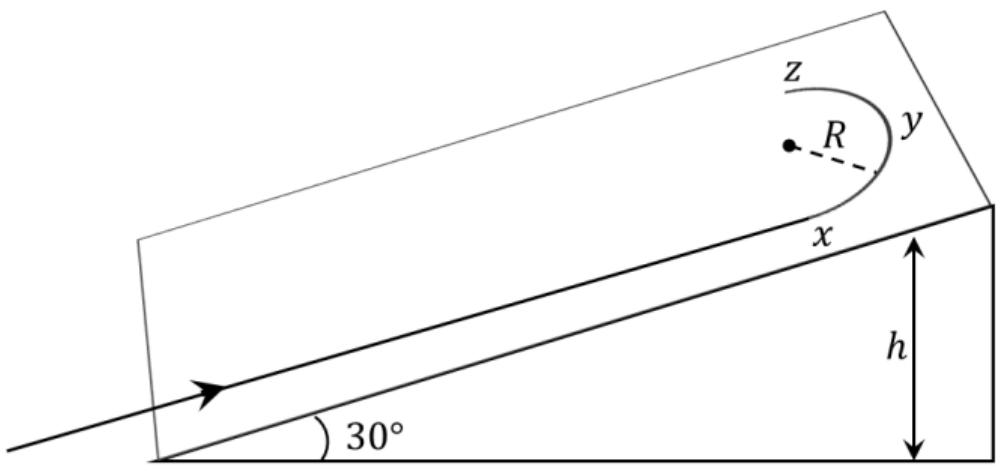
Options
The centripetal force required at points and is zero
The centripetal force required is maximum at points and
Topics & Concepts
Step-by-Step Solution
To determine the correct options, we analyze the skater's motion on the inclined plane using Newton's laws of motion and the principle of conservation of mechanical energy.
1. Analysis at the Highest Point
The inclined ramp makes an angle with the horizontal plane. The component of gravitational acceleration acting along the plane of the incline (directed down the slope) is given by:
At point , which is the peak of the semicircular path of radius , the vector pointing towards the center of curvature is directed straight down the incline plane.
It is given that the centripetal force required for the circular turn at the highest point is supplied solely by the component of the skater's weight along the incline. Therefore:
Solving for :
2. Conservation of Mechanical Energy
Since energy dissipation is negligible, the total mechanical energy is conserved between the starting point at the bottom of the ramp (height , speed ) and point (height , speed ):
Dividing by :
Substituting into the equation:
This proves that Option (A) is correct and Option (B) is incorrect.
3. Evaluation of Centripetal Force at Points and
The required centripetal force at any point on the semicircular path of radius is given by:
The height of points and on the inclined ramp is less than the peak height at point :
By conservation of energy, the speed at any point at height is:
Since points and are at the lowest elevation along the semicircular arc , the skater's speed reaches its maximum value at points and :
Since the speed is maximum at points and , the required centripetal force is also maximum at points and .
This proves that Option (D) is correct and Option (C) is incorrect.
Conclusion
- Correct Options: (A) and (D)