Angular Speed of Pivoted Rod Hit by Embedded Bullet
A uniform rod of mass and length , suspended vertically from a top pivot, is struck horizontally by a bullet of identical mass moving with speed at a distance from the pivot. The bullet gets embedded into the rod. The combined assembly begins to rotate with angular speed around the pivot. If the peak angular speed is attained when , select the correct option(s):
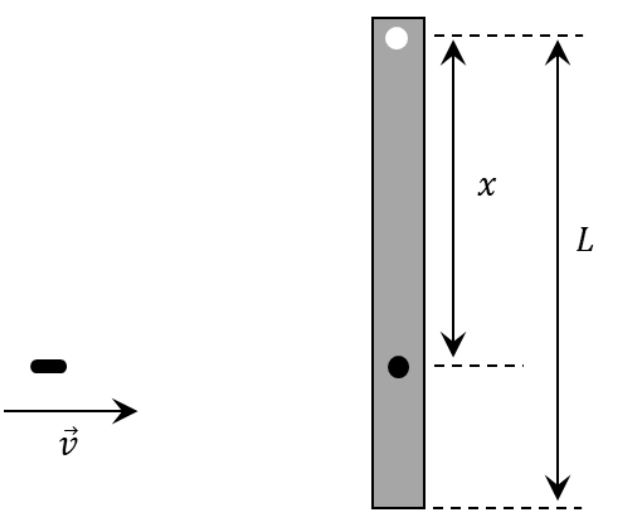
Options
Step-by-Step Solution
To determine the correct statements, we analyze the collision of the bullet with the pivoted rod using the principle of conservation of angular momentum about the pivot.
1. Conservation of Angular Momentum
Since no external horizontal torque acts on the system about the pivot during the collision, the total angular momentum about the pivot is conserved.
-
Initial Angular Momentum (): Only the bullet contributes to the angular momentum about the pivot before the collision:
-
Moment of Inertia of the Combined System (): The system consists of the rod of mass and length , and the embedded bullet of mass at distance from the pivot:
-
Final Angular Momentum ():
Equating and :
This confirms that Option (A) is correct and Option (B) is incorrect.
2. Maximum Angular Speed () and Corresponding Distance ()
To find the distance that maximizes the angular speed , we differentiate with respect to and set the derivative to zero:
Since , it lies within the physical range of the rod ().
This confirms that Option (C) is correct.
3. Value of Maximum Angular Speed ()
Substituting into the expression for :
This confirms that Option (D) is correct.
Conclusion
The correct options are A, C, and D.