Apparent Depth and Curvature Radius of Rotating Liquid Surface
A beaker having radius contains water (refractive index ) filled up to a height , as illustrated in the figure on the left. The beaker rests on a horizontal turntable rotating with an angular velocity . Consequently, the water surface curves such that the height difference between the center and the perimeter of the beaker is (, ), as depicted in the figure on the right. Assuming this surface is nearly spherical with radius of curvature , which of the following statements is/are correct? ( denotes the acceleration due to gravity)
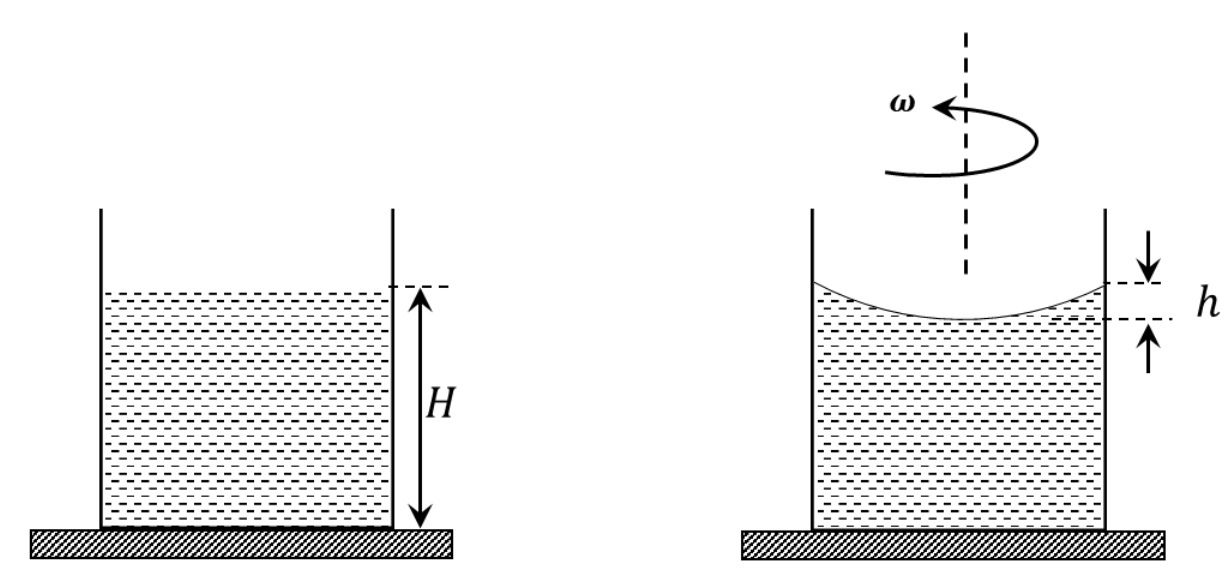
Options
The apparent depth of the bottom of the beaker is close to
The apparent depth of the bottom of the beaker is close to
Step-by-Step Solution
To determine which of the statements are correct, we analyze the geometry of the curved liquid surface and the optical refraction through it step-by-step.
1. Determination of Radius of Curvature ()
The question states that the water surface is approximately spherical. Consider the cross-section of a spherical cap:
- Let the lowest point (center) of the water surface be the origin/pole.
- The height difference between the rim (radius ) and the center is .
- The center of curvature lies at a distance vertically above the lowest point.
Using the Pythagorean theorem for the right-angled triangle formed by the center of curvature, the center of the circular rim, and a point on the rim:
Expanding the equation:
Rearranging terms to solve for :
Thus, Option (A) is correct and Option (B) is incorrect.
2. Radius of Curvature at the Center of the Rotating Liquid
The profile of a liquid surface rotating with angular velocity forms a paraboloid of revolution given by:
The radius of curvature at the lowest point () is calculated as:
Differentiating :
Substituting these into the expression for :
3. Determination of the Apparent Depth
Since , the depth of water at the center can be approximated as .
Now, consider the refraction of light rays from an object at the bottom of the beaker viewed normally from above through the curved surface:
- Refractive index of medium 1 (water):
- Refractive index of medium 2 (air):
- Object distance:
- Radius of curvature: Since the center of curvature lies in air (above the surface),
Applying the spherical surface refraction formula:
Substituting the known values:
Taking the magnitude to find the apparent depth :
Substituting :
Thus, Option (D) is correct and Option (C) is incorrect.
Conclusion
energy The correct statements are A and D.