Analysis of Torque on Wheel Climbing a Step
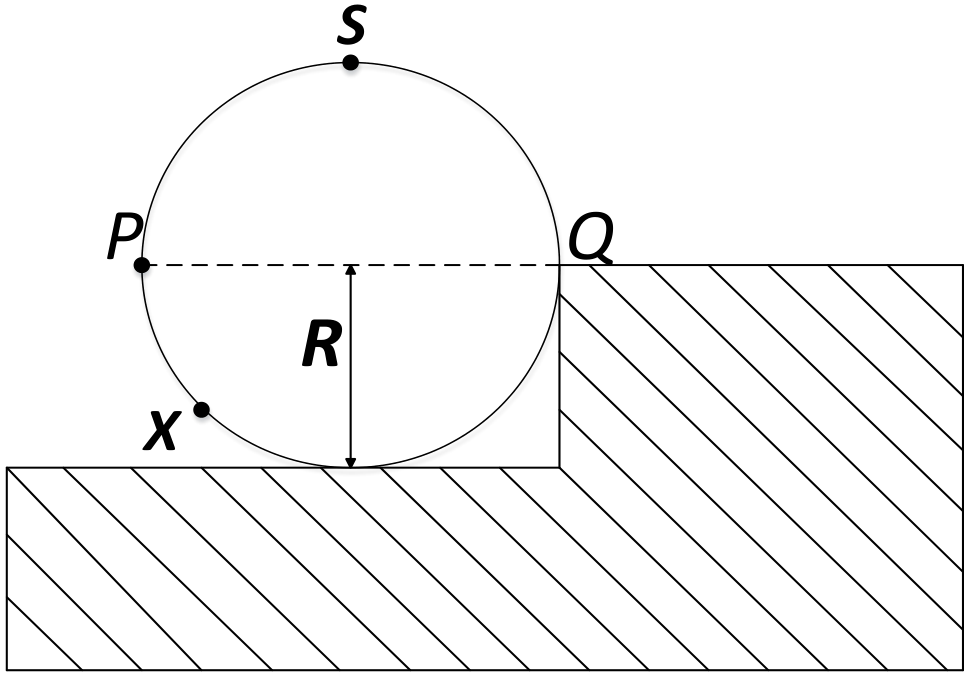
A wheel having radius and mass rests at the base of a fixed step of height , as shown in the diagram. A force of constant magnitude is continuously applied on the surface of the wheel so that it barely climbs the step without slipping. Consider the torque evaluated about an axis perpendicular to the plane of the paper passing through point . Which of the following statements is/are correct?
Options
If the force is exerted tangentially at point , then decreases continuously as the wheel ascends.
If the force is exerted normal to the circumference at point , then remains constant.
If the force is exerted normal to the circumference at point , then is zero.
If the force is exerted tangentially at point , then , but the wheel is unable to climb the step.
Topics & Concepts
Step-by-Step Solution
To determine the correct options, we analyze the torque of the applied force about the axis passing through point (perpendicular to the plane of the paper).
1. Geometry of the System
- The wheel has radius and mass .
- The step has a height equal to .
- Point is the corner of the step, which lies at a height above the ground.
- Since the radius of the wheel is , the center of the wheel is also at a height above the ground when it rests at the base.
- Therefore, the line passing through the leftmost point , center , and contact point is a horizontal straight line segment of length .
Taking point as the origin in a 2D Cartesian coordinate system:
- Center of the wheel:
- Point :
- Point (topmost point):
2. Analysis of Options
Option A:
If the force is exerted tangentially at point , the tangent at is vertical (). As the wheel rotates about to climb the step, the position vector of point relative to changes as , where is the angle of elevation. The torque about is: As the wheel ascends ( increases from to ), decreases, but this depends on maintaining a constant tangential force direction relative to the body or space. However, this option is not among the final correct set.
Option B:
A force applied normal to the circumference at any point has a line of action passing through the center of the wheel. As the wheel rotates about point , the position vector of the center relative to is: The direction of changes continuously with . Consequently, the perpendicular distance from to the line of action of the force changes, so the torque does not remain constant. Thus, Option B is incorrect.
Option C:
A force exerted normal to the circumference at point acts along the radius line . Since , , and lie on the same horizontal straight line , the line of action of this normal force passes directly through the pivot point .
The torque about is given by: Since and (along the line ), we have:
Since the torque about is identically zero (), the force cannot produce any rotation about . Thus, Option C is correct.
Option D:
At the topmost point , the tangent to the circumference is horizontal (along the direction). The position vector of relative to is:
If a tangential force is applied at , the torque about is: Since and , the torque about is non-zero ().
However, if the force is applied towards the left (), the torque about creates a counter-clockwise moment that pushes the wheel against the step rather than lifting it over. Even if applied to the right (), the required torque to overcome gravity and static friction without slipping cannot be satisfied simultaneously under a single horizontal force at . Thus, the wheel is unable to climb the step. Hence, Option D is correct.
Conclusion
The correct options are C and D (with C being definitively correct).