Minimum Angular Velocity to Prevent Ring Slipped Off Finger
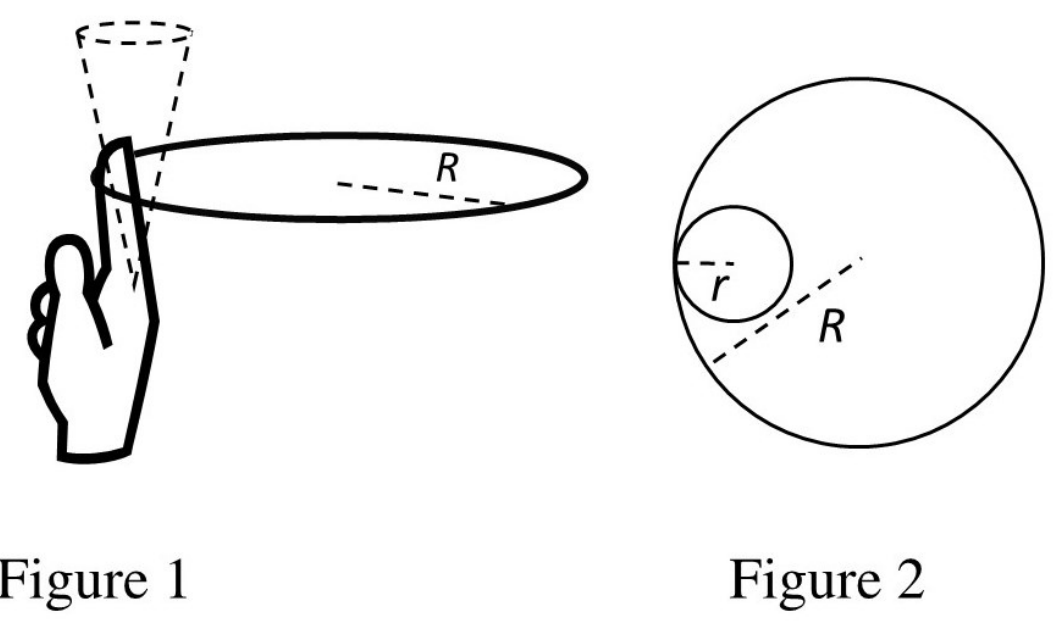
Consider a circular ring of mass and radius twirled near the tip of a finger as illustrated. During this motion, the finger constantly maintains contact with the inner rim of the ring. The finger traces out the surface of a cone. The contact point between the ring and the finger traces a circular path of radius . The finger rotates with an angular speed . The ring performs rolling without slipping on the outer boundary of the smaller circle described by the contact point. The coefficient of friction between the ring and finger is , and the acceleration due to gravity is .
Find the minimum threshold value of required so that the ring does not slip down.
Options
Topics & Concepts
Step-by-Step Solution
To find the minimum threshold angular speed required to prevent the ring from slipping down, we analyze the motion and forces acting on the ring.
1. Motion of the Center of Mass of the Ring
Let the origin be the center of the circular path traced by the contact point (having radius ).
Since the contact point between the finger and the inner rim of the ring is always at a distance from and from the center of mass of the ring, the distance between and is:
The line rotates with an angular speed . Therefore, the center of mass of the ring undergoes uniform circular motion of radius with angular speed .
The centripetal acceleration of the ring's center of mass is directed towards and is given by:
2. Normal Force Analysis
The only force providing the necessary horizontal centripetal force to the ring is the normal force exerted by the finger at the contact point. By Newton's second law in the horizontal radial direction:
3. Friction and Vertical Equilibrium
In the vertical direction, two forces act on the ring:
- Downward gravitational force .
- Upward static friction force exerted by the finger.
For the ring not to slip vertically, the vertical forces must balance:
The condition to prevent the ring from slipping down is that the required static friction force must be less than or equal to the maximum static friction force :
Substituting and :
Dividing both sides by :
Solving for :
Thus, the minimum value of below which the ring will drop down is:
Correct Answer: A