Maximum Velocity for Pure Rolling of Spring Attached Disk
A uniform thin cylindrical disk of mass and radius is attached to two identical massless springs of spring constant which are fixed to the wall as shown in the figure. The springs are attached to the axle of the disk symmetrically on either side at a distance from its centre. The axle is massless and both the springs and the axle are in a horizontal plane. The unstretched length of each spring is . The disk is initially at its equilibrium position with its centre of mass (CM) at a distance from the wall. The disk rolls without slipping with velocity . The coefficient of friction is .
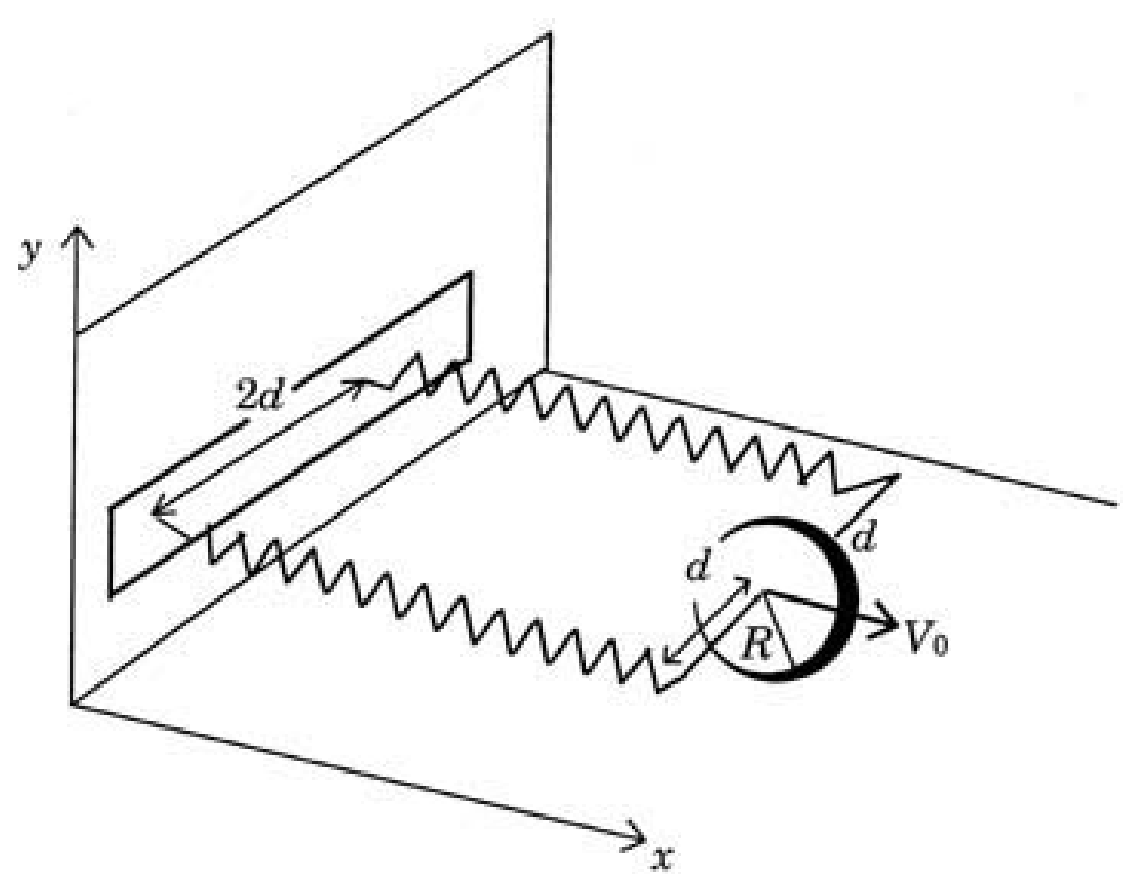
The maximum value of for which the disk will roll without slipping is
Options
Topics & Concepts
Step-by-Step Solution
To find the maximum initial velocity for which the disk rolls without slipping, we analyze the equations of motion for the disk undergoing Simple Harmonic Motion (SHM).
1. Equations of Motion
Let be the displacement of the center of mass of the disk from its equilibrium position. Two springs, each of constant , are attached to the disk, giving a total spring force of .
Let be the static friction force acting on the disk at the contact point in the direction of motion.
For the translational motion of the center of mass:
For the rotational motion about the center of mass:
Since the disk is a uniform thin cylinder, its moment of inertia is . Substituting this gives:
For pure rolling without slipping, the condition connecting linear acceleration and angular acceleration is:
Substituting :
2. Angular Frequency of SHM
Substitute into equation (1):
This represents SHM of the form , where the angular frequency is:
3. Maximum Friction Force
From equation (2), the magnitude of the static friction force at a displacement is:
The friction force reaches its maximum magnitude when the displacement reaches the amplitude of the motion:
4. Condition for Rolling Without Slipping
To prevent slipping, the maximum friction force required must not exceed the maximum possible static friction force:
5. Maximum Initial Velocity
At the equilibrium position (), the speed of the disk is maximum and equals the amplitude times the angular frequency:
Substituting into the condition for no slipping:
Solving for :
Thus, the maximum value of for which the disk will roll without slipping is:
Correct Answer: C