JEE Challenger
More from Electric Charges and Fields

Maximum Charge Density Value for Zero Core Radius

Comprehension Passage

Paragraph for Question Nos. 36 to 38

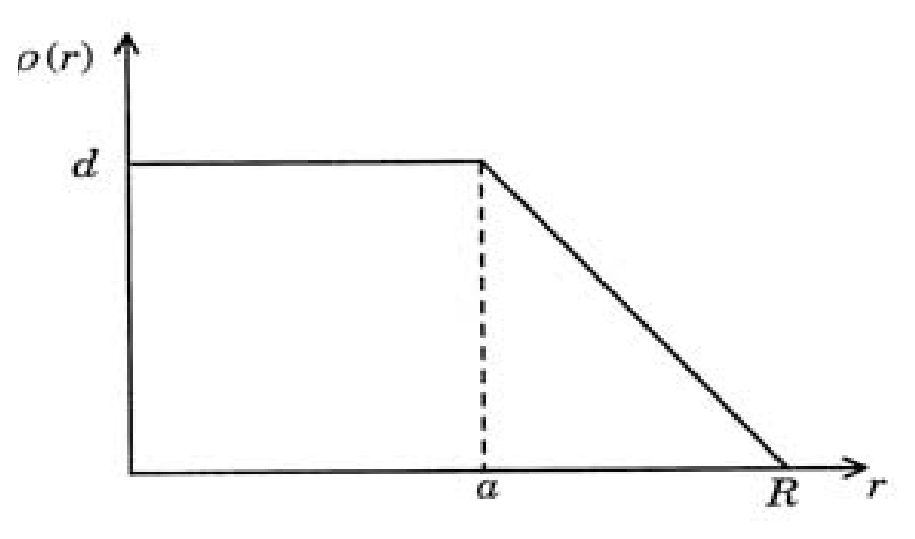
The nuclear charge (Ze)(Ze) is non-uniformly distributed within a nucleus of radius RR. The charge density ρ(r)\rho(r) [charge per unit volume] is dependent only on the radial distance rr from the centre of the nucleus as shown in figure. The electric field is only along the radial direction.
Passage Diagram 0

For a=0a = 0, the value of dd (maximum value of ρ\rho as shown in the figure) is

Options

A

3Ze4πR3\frac{3Ze}{4\pi R^3}

B

3ZeπR3\frac{3Ze}{\pi R^3}

Correct
C

4Ze3πR3\frac{4Ze}{3\pi R^3}

D

Ze3πR3\frac{Ze}{3\pi R^3}

Step-by-Step Solution

To find the maximum charge density dd when a=0a = 0, we analyze the given charge density distribution ρ(r)\rho(r).

From the figure, the variation of charge density ρ(r)\rho(r) with radial distance rr for a≤r≤Ra \le r \le R is given by a straight line joining (a,d)(a, d) and (R,0)(R, 0):
ρ(r)=d(1−r−aR−a)\rho(r) = d \left(1 - \frac{r - a}{R - a}\right)

For a=0a = 0, the charge density simplifies to:
ρ(r)=d(1−rR)for 0≤r≤R\rho(r) = d \left(1 - \frac{r}{R}\right) \quad \text{for } 0 \le r \le R

The total charge Q=ZeQ = Ze distributed within the nucleus of radius RR is obtained by integrating the charge over thin spherical shells of radius rr and thickness drdr:
Ze=∫0Rρ(r)⋅4πr2 drZe = \int_{0}^{R} \rho(r) \cdot 4\pi r^2 \, dr

Substituting the expression for ρ(r)\rho(r):
Ze=4πd∫0R(1−rR)r2 drZe = 4\pi d \int_{0}^{R} \left(1 - \frac{r}{R}\right) r^2 \, dr
Ze=4πd∫0R(r2−r3R) drZe = 4\pi d \int_{0}^{R} \left(r^2 - \frac{r^3}{R}\right) \, dr

Evaluating the integral:
Ze=4πd[r33−r44R]0RZe = 4\pi d \left[ \frac{r^3}{3} - \frac{r^4}{4R} \right]_{0}^{R}
Ze=4πd(R33−R34)Ze = 4\pi d \left( \frac{R^3}{3} - \frac{R^3}{4} \right)
Ze=4πd(R312)Ze = 4\pi d \left( \frac{R^3}{12} \right)
Ze=πdR33Ze = \frac{\pi d R^3}{3}

Solving for dd:
d=3ZeπR3d = \frac{3Ze}{\pi R^3}

Thus, the correct option is B.