Electric Field at Nucleus Boundary for Non-Uniform Charge Distribution
Paragraph for Question Nos. 36 to 38
The nuclear charge is non-uniformly distributed within a nucleus of radius . The charge density [charge per unit volume] is dependent only on the radial distance from the centre of the nucleus as shown in figure. The electric field is only along the radial direction.
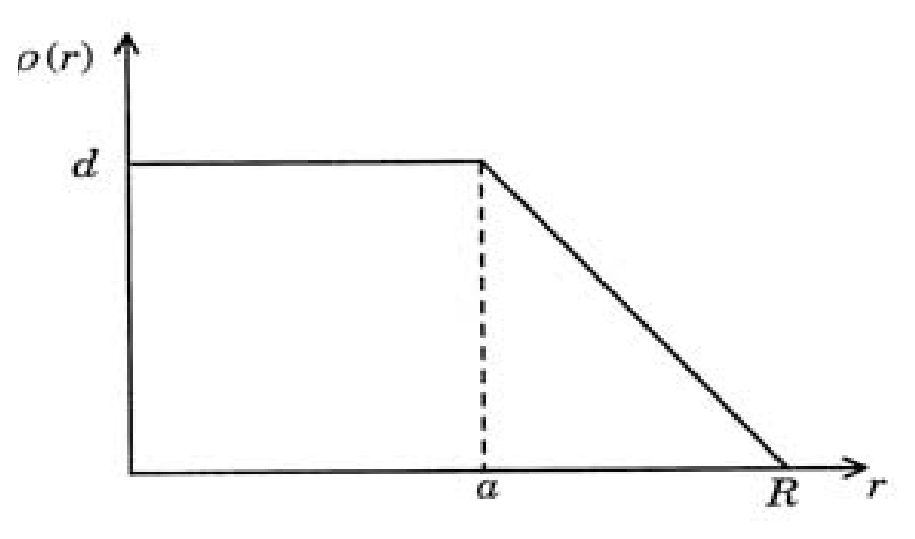
The electric field at is
Options
independent of
directly proportional to
directly proportional to
inversely proportional to
Topics & Concepts
Step-by-Step Solution
To find the electric field at the boundary of the nucleus (), we apply Gauss's Law to a spherical Gaussian surface of radius centered at the origin of the nucleus.
According to Gauss's Law, the total electric flux through a closed Gaussian surface is equal to the total charge enclosed by the surface divided by the permittivity of free space ():
Since the charge density is spherically symmetric, the electric field at is purely radial and has a uniform magnitude over the entire surface of the sphere of radius .
The area of the spherical surface at is . Therefore, the left-hand side of Gauss's Law simplifies to:
The total nuclear charge enclosed within the nucleus of radius is given to be , which is a constant:
Substituting this into Gauss's Law yields:
Solving for :
From this equation, it is evident that the electric field at depends only on the total nuclear charge and the overall radius . It is completely independent of the internal distribution parameter .
Therefore, the electric field at is independent of .
Correct Option: A