Matching Friction Expression on Inclined Plane for Two Contact Blocks
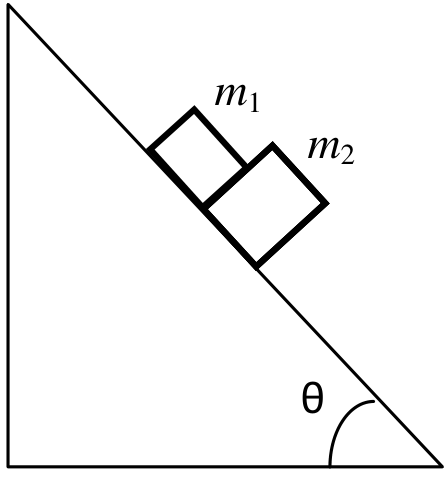
Two blocks with masses and are placed together on an inclined plane with inclination angle , as shown in the diagram. List I lists different values of . The friction coefficient between block and the plane is zero, whereas both static and dynamic friction coefficients between block and the plane equal . List II contains expressions representing the friction force acting on block . Match each inclination angle from List I with the corresponding friction expression in List II, and select the correct choice. Let represent the acceleration due to gravity.
[Useful information: ]
Options
P-1, Q-1, R-1, S-3
P-2, Q-2, R-2, S-3
P-2, Q-2, R-2, S-4
P-2, Q-2, R-3, S-3
Topics & Concepts
Step-by-Step Solution
To determine the friction force acting on block for different angles of inclination , let us analyze the force equilibrium of the two-block system placed on the inclined plane.
1. Analysis of the System and Critical Angle Calculation
Block (mass ) is frictionless (), so it tends to slide down the incline under its own component of weight, pushing block (mass ) from behind. Block experiences a friction force from the inclined surface, where the coefficient of friction is .
The total downward gravitational force parallel to the incline for both blocks is:
The normal force on block from the inclined plane is:
Thus, the maximum static friction force that can act on block is:
For the two blocks to remain in static equilibrium (no slipping):
Dividing both sides by , we get the condition for no slipping:
Substitute the given numerical values , , and :
From the useful information provided, . Therefore, the critical angle of inclination is:
2. Evaluation for Different Inclination Angles
-
Case P: Since , the system is in static equilibrium and does not slip. The static friction force balances the total force acting down the incline: This corresponds to List II - 2.
-
Case Q: Since , the system remains in static equilibrium. The static friction force is: This corresponds to List II - 2.
-
Case R: Since , the blocks overcome static friction and slide down the incline. The friction force is kinetic friction: This corresponds to List II - 3.
-
Case S: Since , the blocks are sliding down the incline. The friction force is kinetic friction: This corresponds to List II - 3.
Conclusion
Matching List I with List II:
- P 2
- Q 2
- R 3
- S 3
This matches the combination given in Option D.