JEE Challenger
More from Ray Optics and Optical Instruments

Focal Length of Thin Lens Combinations in Contact

Four distinct combinations of two thin lenses are presented in List I. Every curved surface has a radius of curvature equal to rr, and all lenses have a refractive index of 1.51.5. Pair each lens arrangement in List I with its effective focal length in List II, and select the correct option.

List IList IIP. [Lens combination P]1. 2rQ. [Lens combination Q]2. r/2R. [Lens combination R]3. −rS. [Lens combination S]4. r\begin{array}{ll} \text{List I} & \text{List II} \\ \text{P. [Lens combination P]} & 1.\ 2r \\ \text{Q. [Lens combination Q]} & 2.\ r/2 \\ \text{R. [Lens combination R]} & 3.\ -r \\ \text{S. [Lens combination S]} & 4.\ r \end{array}
Question Diagram 1
Question Diagram 2
Question Diagram 3
Question Diagram 4

Options

A

P-1, Q-2, R-3, S-4

B

P-2, Q-4, R-3, S-1

Correct
C

P-4, Q-1, R-2, S-3

D

P-2, Q-1, R-3, S-4

Step-by-Step Solution

To find the effective focal length of each combination of thin lenses, we use the Lens Maker's Formula:

1f=(μ−1)(1R1−1R2)\frac{1}{f} = (\mu - 1)\left(\frac{1}{R_1} - \frac{1}{R_2}\right)

Given that the refractive index of all lenses is μ=1.5\mu = 1.5 and the magnitude of the radius of curvature of each curved surface is rr.

For thin lenses in contact, the effective focal length FF is given by:

1F=1f1+1f2\frac{1}{F} = \frac{1}{f_1} + \frac{1}{f_2}


1. Combination P:

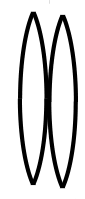
Combination P consists of two identical equiconvex lenses in contact.

For a single equiconvex lens: 1f1=(1.5−1)(1r−(−1r))=0.5×2r=1r  ⟹  f1=r\frac{1}{f_1} = (1.5 - 1)\left(\frac{1}{r} - \left(-\frac{1}{r}\right)\right) = 0.5 \times \frac{2}{r} = \frac{1}{r} \implies f_1 = r

For two such lenses in contact: 1FP=1f1+1f1=1r+1r=2r  ⟹  FP=r2\frac{1}{F_P} = \frac{1}{f_1} + \frac{1}{f_1} = \frac{1}{r} + \frac{1}{r} = \frac{2}{r} \implies F_P = \frac{r}{2}

Thus, P matches with 2.


2. Combination Q:

Combination Q consists of two identical plano-convex lenses in contact.

For a single plano-convex lens: 1f1=(1.5−1)(1r−1∞)=0.5r=12r  ⟹  f1=2r\frac{1}{f_1} = (1.5 - 1)\left(\frac{1}{r} - \frac{1}{\infty}\right) = \frac{0.5}{r} = \frac{1}{2r} \implies f_1 = 2r

For two such lenses in contact: 1FQ=12r+12r=1r  ⟹  FQ=r\frac{1}{F_Q} = \frac{1}{2r} + \frac{1}{2r} = \frac{1}{r} \implies F_Q = r

Thus, Q matches with 4.


3. Combination R:

Combination R consists of two identical plano-concave lenses in contact.

For a single plano-concave lens: 1f1=(1.5−1)(1∞−1r)=−0.5r=−12r  ⟹  f1=−2r\frac{1}{f_1} = (1.5 - 1)\left(\frac{1}{\infty} - \frac{1}{r}\right) = -\frac{0.5}{r} = -\frac{1}{2r} \implies f_1 = -2r

For two such lenses in contact: 1FR=(−12r)+(−12r)=−1r  ⟹  FR=−r\frac{1}{F_R} = \left(-\frac{1}{2r}\right) + \left(-\frac{1}{2r}\right) = -\frac{1}{r} \implies F_R = -r

Thus, R matches with 3.


4. Combination S:

Combination S consists of one plano-concave lens and one equiconvex lens in contact.

  • For the plano-concave lens: f1=−2rf_1 = -2r
  • For the equiconvex lens: f2=rf_2 = r

The effective focal length FSF_S is: 1FS=1f1+1f2=−12r+1r=12r  ⟹  FS=2r\frac{1}{F_S} = \frac{1}{f_1} + \frac{1}{f_2} = -\frac{1}{2r} + \frac{1}{r} = \frac{1}{2r} \implies F_S = 2r

Thus, S matches with 1.


Conclusion:

The correct matching is: P-2, Q-4, R-3, S-1\text{P-2, Q-4, R-3, S-1}

This corresponds to Option B.