JEE Challenger
More from Electric Charges and Fields

Match Signs of Four Point Charges to Direction of Force on a Test Charge

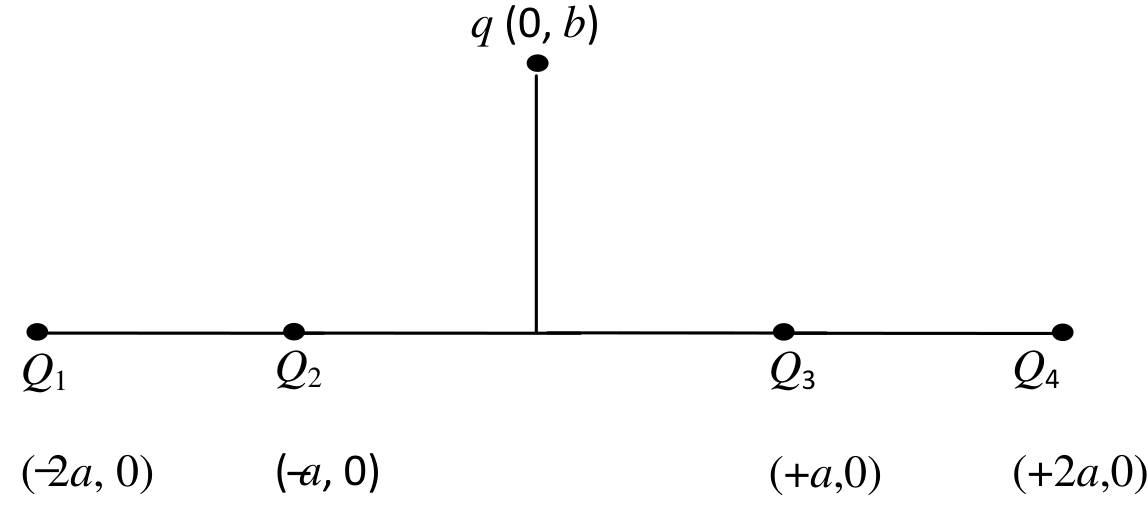
Four charges Q1Q_1, Q2Q_2, Q3Q_3, and Q4Q_4 with identical magnitude are fixed along the xx-axis at x=−2ax = -2a, −a-a, +a+a, and +2a+2a, respectively. A positive point charge qq is located on the positive yy-axis at a distance b>0b > 0. Four cases regarding the signs of these charges are given in List I. The resulting direction of the net force on charge qq is specified in List II. Match List I with List II and choose the correct option using the given code.

List IList IIP. Q1,Q2,Q3,Q4 all positive1. +xQ. Q1,Q2 positive; Q3,Q4 negative2. −xR. Q1,Q4 positive; Q2,Q3 negative3. +yS. Q1,Q3 positive; Q2,Q4 negative4. −y\begin{array}{ll} \text{List I} & \text{List II} \\ \text{P. } Q_1, Q_2, Q_3, Q_4 \text{ all positive} & \text{1. } +x \\ \text{Q. } Q_1, Q_2 \text{ positive; } Q_3, Q_4 \text{ negative} & \text{2. } -x \\ \text{R. } Q_1, Q_4 \text{ positive; } Q_2, Q_3 \text{ negative} & \text{3. } +y \\ \text{S. } Q_1, Q_3 \text{ positive; } Q_2, Q_4 \text{ negative} & \text{4. } -y \end{array}
Question Diagram 1

Options

A

P-3, Q-1, R-4, S-2

Correct
B

P-4, Q-2, R-3, S-1

C

P-3, Q-1, R-2, S-4

D

P-4, Q-2, R-1, S-3

Step-by-Step Solution

To determine the direction of the net electrostatic force on the positive test charge qq located at (0,b)(0, b), we calculate the force contribution from each of the four fixed point charges Q1,Q2,Q3,Q_1, Q_2, Q_3, and Q4Q_4 located at (−2a,0)(-2a, 0), (−a,0)(-a, 0), (+a,0)(+a, 0), and (+2a,0)(+2a, 0), respectively.

1. General Force Expression

The position vector of the test charge qq is r⃗q=bj^\vec{r}_q = b\hat{j}. The position vectors of the four charges are: r⃗1=−2ai^,r⃗2=−ai^,r⃗3=ai^,r⃗4=2ai^\vec{r}_1 = -2a\hat{i}, \quad \vec{r}_2 = -a\hat{i}, \quad \vec{r}_3 = a\hat{i}, \quad \vec{r}_4 = 2a\hat{i}

Using Coulomb's Law, the force exerted on charge qq by charge QiQ_i is given by: F⃗i=kqQi∣r⃗q−r⃗i∣3(r⃗q−r⃗i)\vec{F}_i = \frac{k q Q_i}{|\vec{r}_q - \vec{r}_i|^3} (\vec{r}_q - \vec{r}_i)

Writing this in component form:

  • For Q1Q_1 at (−2a,0)(-2a, 0): F⃗1=kqQ1(4a2+b2)3/2(2ai^+bj^)\vec{F}_1 = \frac{k q Q_1}{(4a^2 + b^2)^{3/2}} (2a\hat{i} + b\hat{j})

  • For Q2Q_2 at (−a,0)(-a, 0): F⃗2=kqQ2(a2+b2)3/2(ai^+bj^)\vec{F}_2 = \frac{k q Q_2}{(a^2 + b^2)^{3/2}} (a\hat{i} + b\hat{j})

  • For Q3Q_3 at (+a,0)(+a, 0): F⃗3=kqQ3(a2+b2)3/2(−ai^+bj^)\vec{F}_3 = \frac{k q Q_3}{(a^2 + b^2)^{3/2}} (-a\hat{i} + b\hat{j})

  • For Q4Q_4 at (+2a,0)(+2a, 0): F⃗4=kqQ4(4a2+b2)3/2(−2ai^+bj^)\vec{F}_4 = \frac{k q Q_4}{(4a^2 + b^2)^{3/2}} (-2a\hat{i} + b\hat{j})

Let C1=kq(a2+b2)3/2>0C_1 = \frac{k q}{(a^2 + b^2)^{3/2}} > 0 and C2=kq(4a2+b2)3/2>0C_2 = \frac{k q}{(4a^2 + b^2)^{3/2}} > 0. Since a2+b2<4a2+b2a^2 + b^2 < 4a^2 + b^2, we have C1>C2C_1 > C_2.

The net force components are: Fx=2aC2Q1+aC1Q2−aC1Q3−2aC2Q4F_x = 2a C_2 Q_1 + a C_1 Q_2 - a C_1 Q_3 - 2a C_2 Q_4 Fy=bC2Q1+bC1Q2+bC1Q3+bC2Q4F_y = b C_2 Q_1 + b C_1 Q_2 + b C_1 Q_3 + b C_2 Q_4


2. Case-by-Case Analysis

Let ∣Qi∣=Q>0|Q_i| = Q > 0.

Case P: Q1,Q2,Q3,Q4Q_1, Q_2, Q_3, Q_4 all positive (+Q+Q)

  • xx-component: Fx=2aC2Q+aC1Q−aC1Q−2aC2Q=0F_x = 2a C_2 Q + a C_1 Q - a C_1 Q - 2a C_2 Q = 0
  • yy-component: Fy=bC2Q+bC1Q+bC1Q+bC2Q=2bQ(C1+C2)>0F_y = b C_2 Q + b C_1 Q + b C_1 Q + b C_2 Q = 2b Q (C_1 + C_2) > 0

Since Fx=0F_x = 0 and Fy>0F_y > 0, the net force is directed along the +y+y direction (3). P → 3\text{P } \rightarrow \text{ 3}


Case Q: Q1,Q2Q_1, Q_2 positive (+Q+Q); Q3,Q4Q_3, Q_4 negative (−Q-Q)

  • xx-component: Fx=2aC2(+Q)+aC1(+Q)−aC1(−Q)−2aC2(−Q)=4aC2Q+2aC1Q>0F_x = 2a C_2 (+Q) + a C_1 (+Q) - a C_1 (-Q) - 2a C_2 (-Q) = 4a C_2 Q + 2a C_1 Q > 0
  • yy-component: Fy=bC2(+Q)+bC1(+Q)+bC1(−Q)+bC2(−Q)=0F_y = b C_2 (+Q) + b C_1 (+Q) + b C_1 (-Q) + b C_2 (-Q) = 0

Since Fx>0F_x > 0 and Fy=0F_y = 0, the net force is directed along the +x+x direction (1). Q → 1\text{Q } \rightarrow \text{ 1}


Case R: Q1,Q4Q_1, Q_4 positive (+Q+Q); Q2,Q3Q_2, Q_3 negative (−Q-Q)

  • xx-component: Fx=2aC2(+Q)+aC1(−Q)−aC1(−Q)−2aC2(+Q)=0F_x = 2a C_2 (+Q) + a C_1 (-Q) - a C_1 (-Q) - 2a C_2 (+Q) = 0
  • yy-component: Fy=bC2(+Q)+bC1(−Q)+bC1(−Q)+bC2(+Q)=2bQ(C2−C1)F_y = b C_2 (+Q) + b C_1 (-Q) + b C_1 (-Q) + b C_2 (+Q) = 2b Q (C_2 - C_1)

Since C1>C2C_1 > C_2, we have C2−C1<0C_2 - C_1 < 0, which implies Fy<0F_y < 0. Thus, the net force is directed along the −y-y direction (4). R → 4\text{R } \rightarrow \text{ 4}


Case S: Q1,Q3Q_1, Q_3 positive (+Q+Q); Q2,Q4Q_2, Q_4 negative (−Q-Q)

  • yy-component: Fy=bC2(+Q)+bC1(−Q)+bC1(+Q)+bC2(−Q)=0F_y = b C_2 (+Q) + b C_1 (-Q) + b C_1 (+Q) + b C_2 (-Q) = 0
  • xx-component: Fx=2aC2(+Q)+aC1(−Q)−aC1(+Q)−2aC2(−Q)=2aQ(2C2−C1)<0F_x = 2a C_2 (+Q) + a C_1 (-Q) - a C_1 (+Q) - 2a C_2 (-Q) = 2a Q (2C_2 - C_1) < 0

Thus, the net force is directed along the −x-x direction (2). S → 2\text{S } \rightarrow \text{ 2}


Conclusion

Matching the results from List I to List II: P → 3,Q → 1,R → 4,S → 2\text{P } \rightarrow \text{ 3}, \quad \text{Q } \rightarrow \text{ 1}, \quad \text{R } \rightarrow \text{ 4}, \quad \text{S } \rightarrow \text{ 2}

This corresponds to Option A.