Match Optical Components with Properties of Formed Images
An optical component and an object S placed along its optic axis are given in Column I. The distance between the object and the component can be varied. The properties of images are given in Column II. Match all the properties of images from Column II with the appropriate components given in Column I. Indicate your answer by darkening the appropriate bubbles of the matrix given in the ORS.
Column I
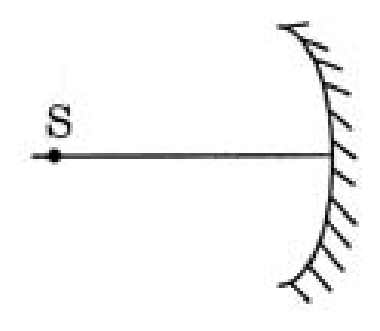
(A) Concave mirror with object S
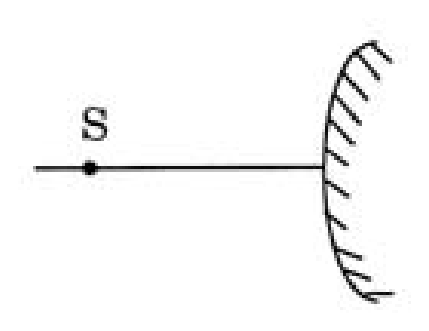
(B) Convex mirror with object S
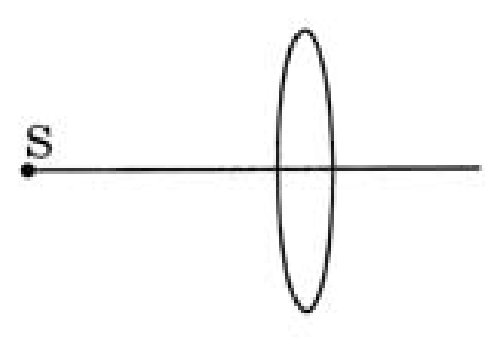
(C) Convex lens with object S
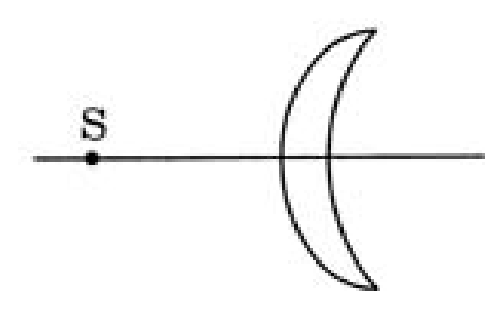
(D) Concave lens with object S
Column II
(p) Real image
(q) Virtual image
(r) Magnified image
(s) Image at infinity
Options
Step-by-Step Solution
To match the optical components in Column I with the properties of the formed images in Column II, we analyze the behavior of light rays for each optical component as the distance of the real object from the component varies.
Analysis of Component (A): Concave Mirror
A concave mirror is a converging optical element with a negative focal length (, let ).
Using the mirror formula:
- Real image (p): When , , which corresponds to a real image formed in front of the mirror.
- Virtual image (q): When , , which corresponds to a virtual image formed behind the mirror.
- Magnified image (r): The magnification is given by .
- For , , producing a magnified real image.
- For , , producing a magnified virtual image.
- Image at infinity (s): When , , so the image is formed at infinity.
Analysis of Component (B): Convex Mirror
A convex mirror is a diverging optical element with a positive focal length ().
Using the mirror formula:
- Since for all real object distances , the image is always virtual (q).
- The magnification magnitude is , so the image is always diminished (never magnified).
- The image is formed between the pole and the focus, so it cannot be real, magnified, or at infinity for any finite real object distance .
Analysis of Component (C): Convex Lens
A biconvex lens is a converging lens with a positive focal length ().
Using the lens formula:
- Real image (p): For , , forming a real image on the opposite side of the lens.
- Virtual image (q): For , , forming a virtual image on the same side as the object.
- Magnified image (r):
- For , magnification (magnified real image).
- For , magnification (magnified virtual image).
- Image at infinity (s): For , , so the image is formed at infinity.
Analysis of Component (D): Concavo-Convex / Meniscus Lens
From the diagram for (D), both surfaces curve in the same direction towards the right, with radii of curvature and . The lens is thicker at the middle than at the edges, which implies .
Using the Lens Maker's Formula:
Since , , which gives .
Thus, this meniscus lens behaves as a converging lens with a positive focal length , exactly like the convex lens in (C):
- Real image (p): Formed when .
- Virtual image (q): Formed when .
- Magnified image (r): Formed when (and ).
- Image at infinity (s): Formed when .
Final Correct Matching:
- A p, q, r, s
- B q
- C p, q, r, s
- D p, q, r, s