Match Expansion Processes of Ideal Gas with Thermodynamic Changes
Column I contains a list of processes involving expansion of an ideal gas. Match this with Column II describing the thermodynamic change during this process. Indicate your answer by darkening the appropriate bubbles of the matrix given in the ORS.
Column I
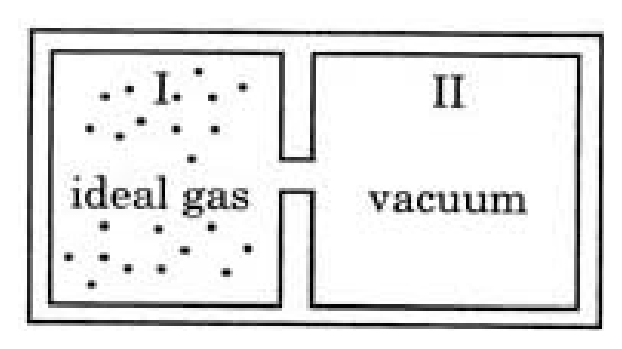
(A) An insulated container has two chambers separated by a valve. Chamber I contains an ideal gas and the Chamber II has vacuum. The valve is opened.
(B) An ideal monoatomic gas expands to twice its original volume such that its pressure , where is the volume of the gas
(C) An ideal monoatomic gas expands to twice its original volume such that its pressure , where is its volume
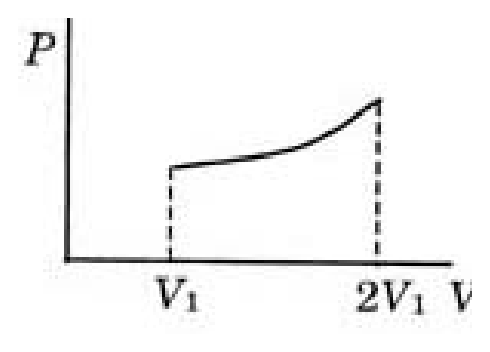
(D) An ideal monoatomic gas expands such that its pressure and volume follows the behaviour shown in the graph
Column II
(p) The temperature of the gas decreases
(q) The temperature of the gas increases or remains constant
(r) The gas loses heat
(s) The gas gains heat
Options
Topics & Concepts
Step-by-Step Solution
To match the expansion processes of the ideal gas in Column I with the thermodynamic changes in Column II, we analyze each case using the First Law of Thermodynamics, , and the ideal gas equation .
Process (A)
- Description: An insulated container has two chambers separated by a valve. Chamber I contains an ideal gas and Chamber II has a vacuum. The valve is opened.
- Analysis:
- Since the container is insulated, no heat enters or leaves the system: .
- Expansion into a vacuum (free expansion) involves no opposing force, so work done is zero: .
- According to the First Law of Thermodynamics:
- For an ideal gas, internal energy depends solely on temperature (). Since , the temperature of the gas remains constant ().
- Matching Options: q
Process (B)
- Description: An ideal monoatomic gas expands to twice its original volume such that .
- Analysis:
- The process is polytropic with (i.e., exponent ).
- Temperature variation:
Since the gas expands (), the temperature decreases (). - Heat calculation:
The molar heat capacity for a polytropic process is given by:
For a monoatomic gas, . Substituting :
The heat absorbed by the gas is:
Since and , we get , which means the gas loses heat.
- Matching Options: p, r
Process (C)
- Description: An ideal monoatomic gas expands to twice its original volume such that .
- Analysis:
- The process is polytropic with .
- Temperature variation:
As volume increases, temperature decreases (). - Heat calculation:
The molar heat capacity is:
The heat absorbed by the gas is:
Since and , we have , which means the gas gains heat.
- Matching Options: p, s
Process (D)
- Description: An ideal monoatomic gas expands such that increases as increases from to , as shown in the graph.
- Analysis:
- Temperature variation:
Since both and increase during expansion, must increase (). - Heat calculation:
- Change in internal energy: (since ).
- Work done: (area under the curve in the diagram is positive as volume increases).
- By the First Law of Thermodynamics:
Thus, the gas gains heat.
- Temperature variation:
- Matching Options: q, s
Final Matching:
- A q
- B p, r
- C p, s
- D q, s