Determine Stability Order of Given Organic Species
The correct stability order for the following species is
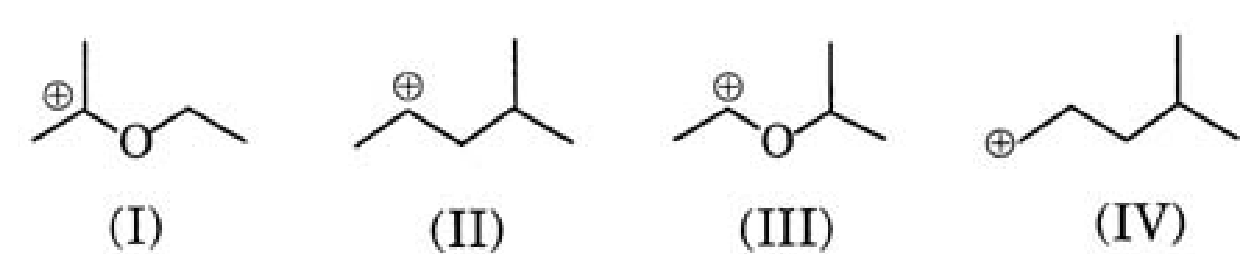
Options
A
B
C
D
Correct
Topics & Concepts
Step-by-Step Solution
To determine the correct stability order of the given organic species, we analyze the electronic effects—such as resonance (mesomeric effect), hyperconjugation, and inductive effect—operating in each species:
-
Resonance Stabilization in Species (I) and (III):
- Both species (I) and (III) have a positively charged carbon directly adjacent to an oxygen atom possessing lone pairs ().
- Oxygen donates a lone pair via the (mesomeric) effect to form a -bond, yielding a major canonical structure where every atom satisfies the octet rule:
- Since complete-octet resonance structures are exceptionally stable, species (I) and (III) are significantly more stable than species (II) and (IV), which lack resonance stabilization and have incomplete octets at the carbocation carbon.
-
Comparison Between (I) and (III):
- Species (I) (): The carbocation carbon is directly attached to a methyl group (), supplying additional stabilization through hyperconjugation () and inductive effect.
- Species (III) (): The carbocation carbon has no directly attached alkyl substituents ().
- Therefore, .
-
Comparison Between (II) and (IV):
- Neither species enjoys resonance stabilization. Their stability is dictated by hyperconjugation and inductive effects:
- Species (II) (): A secondary () carbocation with a total of ( from the methyl group and from the adjacent group).
- Species (IV) (): A primary () carbocation with only (from the adjacent group).
- Since carbocation stability increases with the number of hyperconjugative -hydrogens (), species (II) is more stable than species (IV).
- Therefore, .
Combining these results gives the overall stability order:
Correct Option: D