JEE Challenger
More from Current Electricity

Magnitude of Current in Symmetry Resistance Circuit with Two Batteries

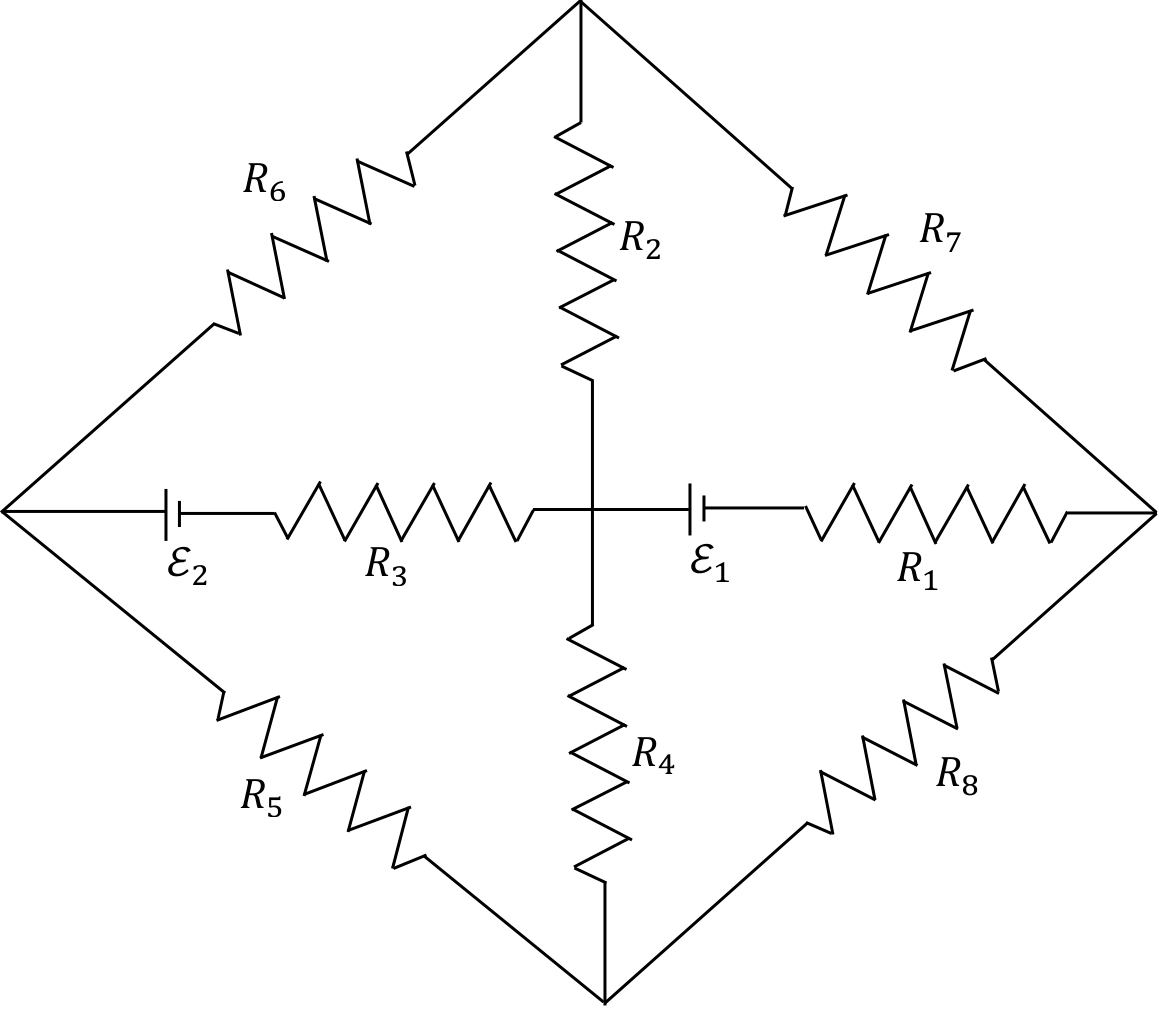
The figure shows a circuit having eight resistances of 1 Ω1\ \Omega each, labelled R1R_1 to R8R_8, and two ideal batteries with voltages E1=12 V\mathcal{E}_1 = 12\text{ V} and E2=6 V\mathcal{E}_2 = 6\text{ V}.

Which of the following statement(s) is(are) correct?

Question Diagram 1

Options

A

The magnitude of current flowing through R1R_1 is 7.2 A7.2\text{ A}.

Correct
B

The magnitude of current flowing through R2R_2 is 1.2 A1.2\text{ A}.

Correct
C

The magnitude of current flowing through R3R_3 is 4.8 A4.8\text{ A}.

Correct
D

The magnitude of current flowing through R5R_5 is 2.4 A2.4\text{ A}.

Correct

Step-by-Step Solution

To determine the magnitude of the current flowing through each resistor, we analyze the circuit using nodal analysis and symmetry.

1. Circuit Symmetry and Node Definitions

Let us define the potentials at key junctions (nodes) in the circuit:

  • Let the central junction be node OO with potential VO=0 VV_O = 0\text{ V} (reference node).
  • Let the leftmost node be LL with potential VLV_L.
  • Let the rightmost node be RR with potential VRV_R.
  • Let the top node be TT with potential VTV_T.
  • Let the bottom node be BB with potential VBV_B.

Due to top-bottom symmetry across the horizontal axis passing through L,O,RL, O, R, the potential at node TT equals the potential at node BB: VT=VBV_T = V_B


2. Applying Kirchhoff's Current Law (KCL)

At Node TT:

Applying KCL at node TT: VTVLR6+VTVRR7+VTVOR2=0\frac{V_T - V_L}{R_6} + \frac{V_T - V_R}{R_7} + \frac{V_T - V_O}{R_2} = 0

Given R1=R2==R8=1 ΩR_1 = R_2 = \dots = R_8 = 1\ \Omega and VO=0 VV_O = 0\text{ V}: (VTVL)+(VTVR)+VT=0(V_T - V_L) + (V_T - V_R) + V_T = 0 3VT=VL+VR    VT=VL+VR33V_T = V_L + V_R \implies V_T = \frac{V_L + V_R}{3}

Since VB=VTV_B = V_T, we also have: VB=VL+VR3V_B = \frac{V_L + V_R}{3}


At Node LL:

The branch between LL and OO contains battery E2=6 V\mathcal{E}_2 = 6\text{ V} and resistor R3R_3. The potential just after the battery (towards R3R_3) is (VLE2)(V_L - \mathcal{E}_2).

Applying KCL at node LL: VLVTR6+VLVBR5+(VLE2)VOR3=0\frac{V_L - V_T}{R_6} + \frac{V_L - V_B}{R_5} + \frac{(V_L - \mathcal{E}_2) - V_O}{R_3} = 0

Substituting VB=VTV_B = V_T and VO=0 VV_O = 0\text{ V}: 2(VLVT)+VL6=02(V_L - V_T) + V_L - 6 = 0 3VL2VT=63V_L - 2V_T = 6

Substituting VT=VL+VR3V_T = \frac{V_L + V_R}{3}: 3VL2(VL+VR3)=63V_L - 2\left(\frac{V_L + V_R}{3}\right) = 6 9VL2VL2VR=189V_L - 2V_L - 2V_R = 18 7VL2VR=18— (Equation 1)7V_L - 2V_R = 18 \quad \text{--- (Equation 1)}


At Node RR:

The branch between OO and RR contains battery E1=12 V\mathcal{E}_1 = 12\text{ V} and resistor R1R_1. The potential just after the battery (towards R1R_1) is (VOE1)=12 V(V_O - \mathcal{E}_1) = -12\text{ V}.

Applying KCL at node RR: VRVTR7+VRVBR8+VR(VOE1)R1=0\frac{V_R - V_T}{R_7} + \frac{V_R - V_B}{R_8} + \frac{V_R - (V_O - \mathcal{E}_1)}{R_1} = 0

Substituting VB=VTV_B = V_T and VO=0 VV_O = 0\text{ V}: 2(VRVT)+VR(12)=02(V_R - V_T) + V_R - (-12) = 0 3VR2VT=123V_R - 2V_T = -12

Substituting VT=VL+VR3V_T = \frac{V_L + V_R}{3}: 3VR2(VL+VR3)=123V_R - 2\left(\frac{V_L + V_R}{3}\right) = -12 9VR2VL2VR=369V_R - 2V_L - 2V_R = -36 2VL+7VR=36— (Equation 2)-2V_L + 7V_R = -36 \quad \text{--- (Equation 2)}


3. Solving for Node Potentials

From Equation 1: VR=7VL182V_R = \frac{7V_L - 18}{2}

Substituting VRV_R into Equation 2: 2VL+7(7VL182)=36-2V_L + 7\left(\frac{7V_L - 18}{2}\right) = -36 4VL+49VL126=72-4V_L + 49V_L - 126 = -72 45VL=54    VL=5445=1.2 V45V_L = 54 \implies V_L = \frac{54}{45} = 1.2\text{ V}

Now calculating VRV_R: VR=7(1.2)182=8.4182=4.8 VV_R = \frac{7(1.2) - 18}{2} = \frac{8.4 - 18}{2} = -4.8\text{ V}

Now calculating VTV_T and VBV_B: VT=VB=1.24.83=3.63=1.2 VV_T = V_B = \frac{1.2 - 4.8}{3} = \frac{-3.6}{3} = -1.2\text{ V}


4. Calculating Currents Through Resistors

  1. Current through R1R_1: IR1=VR(VOE1)R1=4.8(12)1=7.2 AI_{R_1} = \frac{|V_R - (V_O - \mathcal{E}_1)|}{R_1} = \frac{|-4.8 - (-12)|}{1} = 7.2\text{ A} (Statement A is correct)

  2. Current through R2R_2: IR2=VOVTR2=0(1.2)1=1.2 AI_{R_2} = \frac{|V_O - V_T|}{R_2} = \frac{|0 - (-1.2)|}{1} = 1.2\text{ A} (Statement B is correct)

  3. Current through R3R_3: IR3=VO(VLE2)R3=0(1.26)1=4.8 AI_{R_3} = \frac{|V_O - (V_L - \mathcal{E}_2)|}{R_3} = \frac{|0 - (1.2 - 6)|}{1} = 4.8\text{ A} (Statement C is correct)

  4. Current through R5R_5: IR5=VLVBR5=1.2(1.2)1=2.4 AI_{R_5} = \frac{|V_L - V_B|}{R_5} = \frac{|1.2 - (-1.2)|}{1} = 2.4\text{ A} (Statement D is correct)


Conclusion

All four statements (A), (B), (C), and (D) are correct.
Magnitude of Current in Symmetry Resistance Circuit with Two Batteries | Physics PYQ Solution - JEE Challenger