Parallel Plate Capacitor with Dielectric Moved Plates Analysis
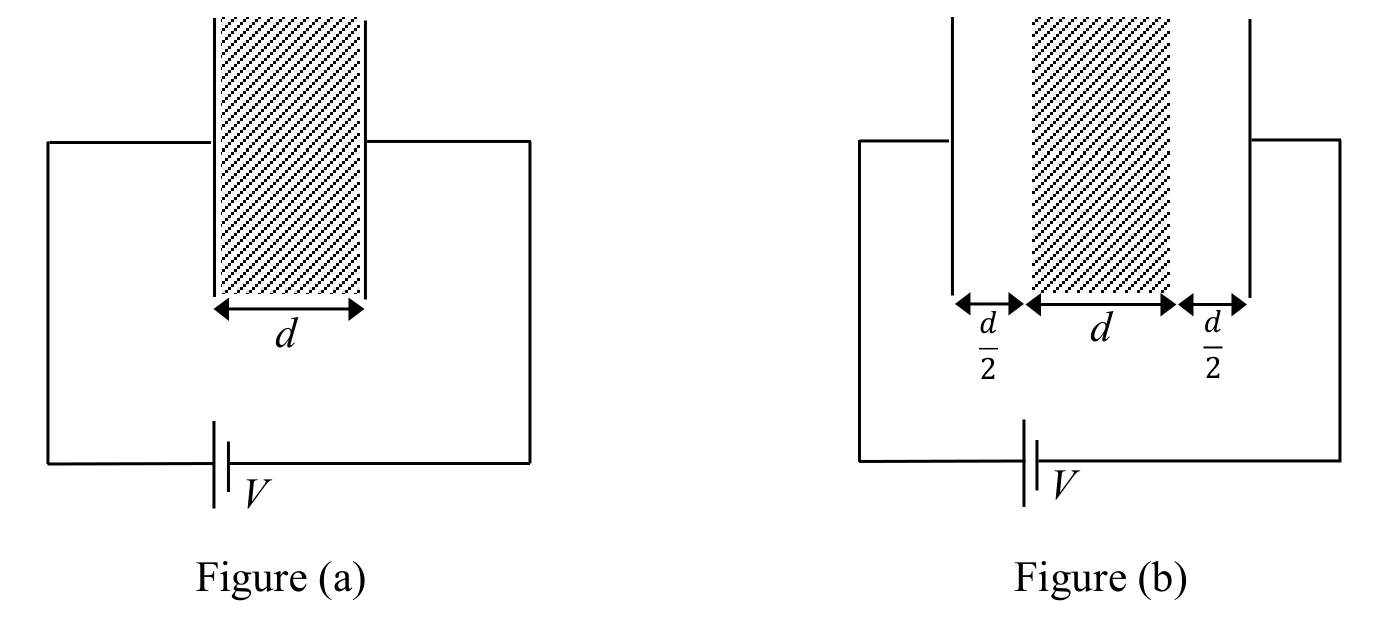
A medium having dielectric constant fills the space between the plates of a parallel plate capacitor. The plates have large area, and the distance between them is . The capacitor is connected to a battery of voltage , as shown in Figure (a). Now, both the plates are moved by a distance of from their original positions, as shown in Figure (b).
In the process of going from the configuration depicted in Figure (a) to that in Figure (b), which of the following statement(s) is(are) correct?
Options
The electric field inside the dielectric material is reduced by a factor of .
The capacitance is decreased by a factor of .
The voltage between the capacitor plates is increased by a factor of .
The work done in the process DOES NOT depend on the presence of the dielectric material.
Step-by-Step Solution
To determine which of the statements are correct, let us analyze the initial and final configurations of the capacitor system connected to the battery of voltage .
1. Initial Configuration (Figure a)
In the initial state, the dielectric medium of thickness and dielectric constant completely fills the space between the parallel plates of area separated by distance .
-
Capacitance ():
-
Voltage ():
-
Charge ():
-
Electric field inside the dielectric ():
2. Final Configuration (Figure b)
Both plates are moved outwards by a distance of each from their original positions. The dielectric block of thickness remains at the center. The new separation between the plates is:
This system can be modeled as three capacitors connected in series:
- An air gap capacitor of thickness with capacitance
- A dielectric-filled capacitor of thickness with capacitance
- An air gap capacitor of thickness with capacitance
-
Equivalent Capacitance ():
Comparing with :
-
Voltage (): Since the battery remains connected across the plates, the potential difference between the plates remains constant:
-
Final Charge ():
-
Electric field inside the dielectric (): The free charge density on the plates is: The electric field in the air gap is: The electric field inside the dielectric material is:
3. Evaluation of Options
-
Option A: The ratio of the initial to final electric field inside the dielectric is: Thus, the electric field inside the dielectric is reduced by a factor of , not .
(Option A is incorrect) -
Option B: The final capacitance is related to by: Therefore, the capacitance is decreased by a factor of (i.e. reduced to of its initial value).
(Option B is correct) -
Option C: Since the capacitor remains connected to the battery of voltage , the voltage between the plates stays constant ().
(Option C is incorrect) -
Option D: The work done by the external agent () in moving the plates is calculated using work-energy theorem:
Substituting and : Since explicitly depends on , the work done does depend on the presence of the dielectric material.
(Option D is incorrect)
Conclusion
The correct option is B.