Magnetic Field at Point near Cylindrical Cavity in Current Conductor
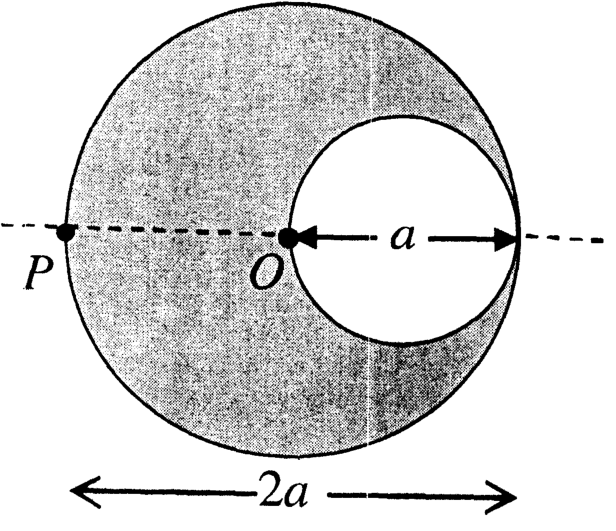
A cylindrical cavity with a diameter is present inside a long cylinder having a diameter , as illustrated in the figure. Both the cylinder and cavity extend infinitely along their length. A uniform current density flows along their length. If the magnitude of the magnetic field at point is given as , then calculate the value of .
Topics & Concepts
Step-by-Step Solution
To find the magnitude of the magnetic field at point , we can use the principle of superposition.
1. Geometry and Coordinate System
Let the center of the main cylinder be the origin .
- The main cylinder has a diameter of , which gives it a radius of .
- Point is located on the outer surface of the main cylinder on the opposite side of the cavity, at coordinates .
- The cylindrical cavity has a diameter of , meaning its radius is . Its center lies on the line connecting and , at coordinates .
Using superposition, the configuration can be treated as the combination of:
- A solid cylinder of radius carrying a uniform current density .
- A smaller cylinder corresponding to the cavity, of radius , centered at , carrying a uniform current density .
2. Magnetic Field due to the Solid Cylinder ()
Point lies on the boundary of the solid cylinder (). By Ampere's Circuital Law:
Assuming the current density flows out of the page (), by the right-hand rule, the magnetic field at points in the direction:
3. Magnetic Field due to the Cavity Cylinder ()
The distance from the center of the cavity to point is:
Since , point lies outside the cavity region. The magnetic field at due to this smaller cylinder carrying total current is:
Since this region carries a current in the direction, the right-hand rule gives the direction of at along the direction:
4. Net Magnetic Field at Point
By superposition, the net magnetic field is:
The magnitude of the magnetic field is:
Comparing this with the given expression , we get: