JEE Challenger
More from System of Particles and Rotational Motion

Ratio of Moments of Inertia for Lamina with Circular Cutout

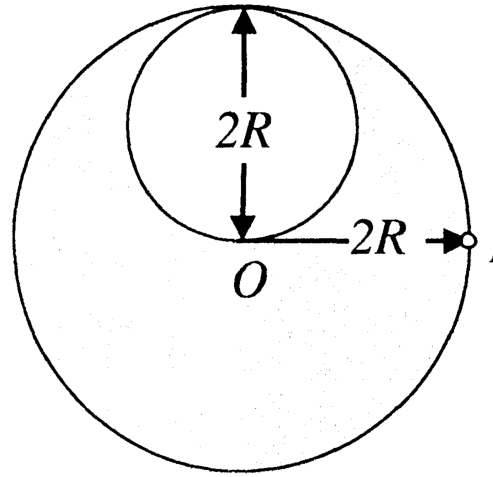
A lamina is constructed by removing a circular disc of diameter 2R2R from a larger uniform disc of radius 2R2R, as depicted in the figure. The moment of inertia of this remaining lamina about perpendicular axes passing through OO and PP are denoted by I0I_0 and IpI_p, respectively. Both axes are normal to the plane of the lamina. The ratio IpI0\frac{I_p}{I_0} rounded to the nearest integer is

Question Diagram 1
Official Numerical Answer3

Step-by-Step Solution

To find the ratio of the moments of inertia IPIO\frac{I_P}{I_O}, we can use the principle of superposition by treating the cut-out lamina as a complete uniform disc of radius 2R2R minus a smaller circular disc of diameter 2R2R (radius RR).

1. Mass Distribution

Let σ\sigma be the uniform mass density per unit area of the disc.

  • The mass of the complete large disc of radius R1=2RR_1 = 2R is: M=σ⋅π(2R)2=4πσR2M = \sigma \cdot \pi (2R)^2 = 4\pi \sigma R^2

  • The mass of the removed small disc of radius r=Rr = R is: m=σ⋅πR2=M4m = \sigma \cdot \pi R^2 = \frac{M}{4}

Set up a Cartesian coordinate system with the origin at the center O(0,0)O(0, 0) of the original disc:

  • The center of the small removed disc is at C(0,R)C(0, R).
  • Point PP lies on the edge of the large disc along the x-axis, at coordinates P(2R,0)P(2R, 0).

2. Moment of Inertia about Axis passing through OO (IOI_O)

  1. For the complete large disc about OO: IO,large=12MR12=12M(2R)2=2MR2I_{O, \text{large}} = \frac{1}{2} M R_1^2 = \frac{1}{2} M (2R)^2 = 2 M R^2

  2. For the removed small disc about OO:

    • Moment of inertia about its own center C(0,R)C(0, R): IC,small=12mr2=12(M4)R2=18MR2I_{C, \text{small}} = \frac{1}{2} m r^2 = \frac{1}{2} \left(\frac{M}{4}\right) R^2 = \frac{1}{8} M R^2
    • Using the parallel axis theorem to shift the axis to OO, where the distance OC=ROC = R: IO,small=IC,small+m(OC)2=18MR2+(M4)R2=38MR2I_{O, \text{small}} = I_{C, \text{small}} + m (OC)^2 = \frac{1}{8} M R^2 + \left(\frac{M}{4}\right) R^2 = \frac{3}{8} M R^2
  3. For the remaining lamina about OO: IO=IO,large−IO,small=2MR2−38MR2=138MR2I_O = I_{O, \text{large}} - I_{O, \text{small}} = 2 M R^2 - \frac{3}{8} M R^2 = \frac{13}{8} M R^2


3. Moment of Inertia about Axis passing through PP (IPI_P)

  1. For the complete large disc about PP:

    • Using the parallel axis theorem, where the distance OP=2ROP = 2R: IP,large=IO,large+M(OP)2=2MR2+M(2R)2=6MR2I_{P, \text{large}} = I_{O, \text{large}} + M (OP)^2 = 2 M R^2 + M (2R)^2 = 6 M R^2
  2. For the removed small disc about PP:

    • The square of the distance between the center of the small disc C(0,R)C(0, R) and point P(2R,0)P(2R, 0) is: CP2=(2R−0)2+(0−R)2=4R2+R2=5R2CP^2 = (2R - 0)^2 + (0 - R)^2 = 4R^2 + R^2 = 5R^2
    • Using the parallel axis theorem: IP,small=IC,small+m(CP)2=18MR2+(M4)(5R2)=18MR2+54MR2=118MR2I_{P, \text{small}} = I_{C, \text{small}} + m (CP)^2 = \frac{1}{8} M R^2 + \left(\frac{M}{4}\right) (5R^2) = \frac{1}{8} M R^2 + \frac{5}{4} M R^2 = \frac{11}{8} M R^2
  3. For the remaining lamina about PP: IP=IP,large−IP,small=6MR2−118MR2=378MR2I_P = I_{P, \text{large}} - I_{P, \text{small}} = 6 M R^2 - \frac{11}{8} M R^2 = \frac{37}{8} M R^2


4. Ratio IPIO\frac{I_P}{I_O}

Taking the ratio of IPI_P to IOI_O: IPIO=378MR2138MR2=3713≈2.846\frac{I_P}{I_O} = \frac{\frac{37}{8} M R^2}{\frac{13}{8} M R^2} = \frac{37}{13} \approx 2.846

Rounding to the nearest integer: IPIO≈3\frac{I_P}{I_O} \approx 3