Electric Field due to Cylinder with Spherical Cavity
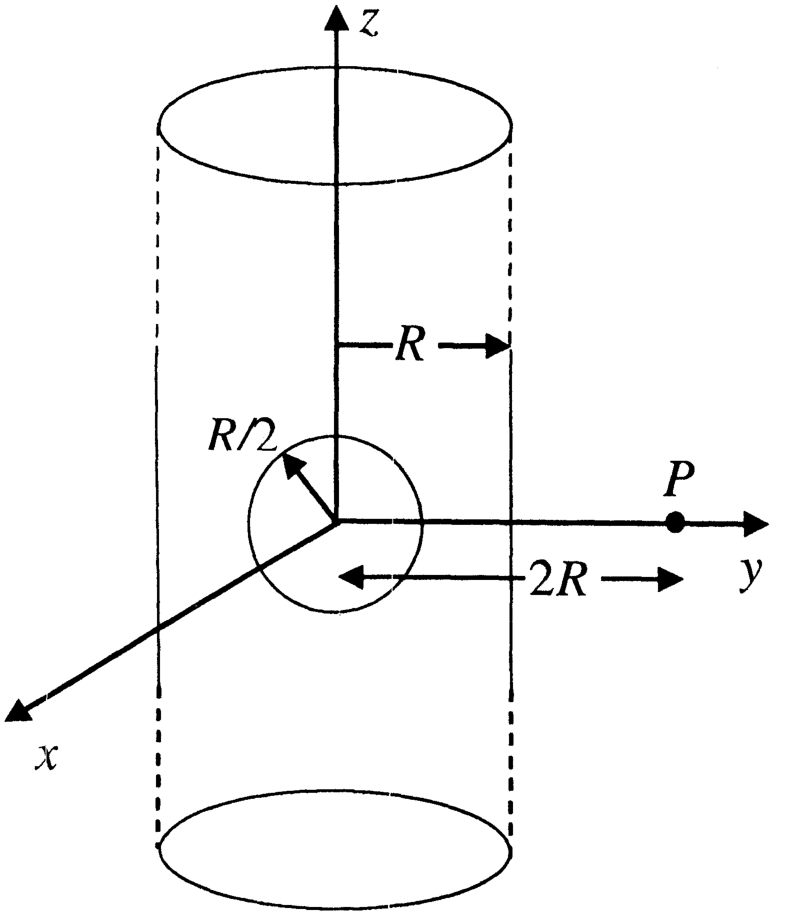
Consider an infinitely long solid cylinder of radius that has a uniform volume charge density . A spherical cavity of radius is created with its center located on the axis of the cylinder, as shown in the diagram. The magnitude of the electric field at point , situated at a distance from the cylinder axis, is expressed as . Find the value of .
Topics & Concepts
Step-by-Step Solution
To find the value of , we use the principle of superposition. The electric field at point can be calculated by subtracting the electric field of the removed spherical cavity (filled with charge density ) from the electric field of a complete, solid infinitely long cylinder of charge density .
Step 1: Electric Field due to the Complete Solid Cylinder
Consider an infinitely long solid cylinder of radius and uniform volume charge density . Point is located at a distance from the axis of the cylinder.
Using Gauss's Law for a coaxial cylindrical Gaussian surface of radius and length :
The enclosed charge in length is:
Thus,
Substituting :
The direction of at point is radially outwards along the y-axis ().
Step 2: Electric Field due to the Removed Spherical Volume
The spherical cavity has a radius of with its center at the origin (on the axis of the cylinder). Point is at a distance of from the center of this sphere.
The total charge of this sphere, assuming it is uniformly filled with volume charge density , is:
Using Coulomb's law (or Gauss's law for a sphere) at an external point :
The direction of at point is also radially outwards along the y-axis ().
Step 3: Net Electric Field at Point
By the principle of superposition, the net electric field at point is:
Taking a common denominator:
Step 4: Finding the Value of
Comparing the derived magnitude with the given expression :