Jump Heights of Rings on Solenoids and Resistivity Relation
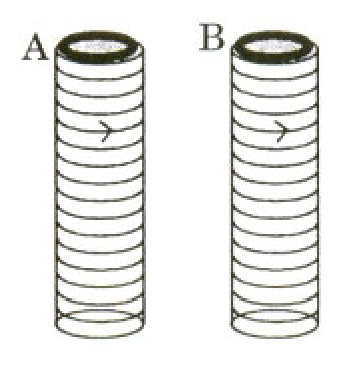
Two metallic rings A and B, identical in shape and size but having different resistivities and , are kept on top of two identical solenoids as shown in the figure. When current is switched on in both the solenoids in identical manner, the rings A and B jump to heights and , respectively, with . The possible relation(s) between their resistivities and their masses and is(are)
Options
and
and
and
and
Topics & Concepts
Step-by-Step Solution
To find the relation between the resistivities and masses of the two rings, we analyze the electromagnetic force and motion of the rings when the current is switched on.
-
Induced EMF and Resistance:
Since both rings and are identical in shape and size and are placed symmetrically on identical solenoids, the rate of change of magnetic flux through each ring is the same during the switching-on of current:
The electrical resistance of a ring is given by:
where is the resistivity, is the perimeter, and is the cross-sectional area of the ring. Since and are identical for both rings:
-
Induced Current and Repulsive Force:
The induced current in the ring is:
The upward electromagnetic force exerted on the ring due to the diverging magnetic field at the end of the solenoid is given by:
where is the radial component of the magnetic field and is the radius of the ring. -
Motion and Jump Height:
The current rises rapidly over a very short time interval , imparting an upward impulse to the ring:
The initial velocity acquired by the ring immediately after the impulse is:
Neglecting air resistance, the maximum height attained by the ring is:
Therefore, the jump height is inversely dependent on both the mass and the resistivity of the ring. A ring will jump higher if it has smaller resistivity and/or smaller mass.
-
Evaluating the Given Conditions:
We are given that:
-
Case 1: If , then for , ring must experience a greater upward force, which requires:
This matches option (B). -
Case 2: If and , both the lower resistivity and the smaller mass contribute to giving ring a larger acceleration and initial velocity, definitively ensuring:
This matches option (D). -
Options (A) and (C): Both state with , which would result in , contradicting the given condition.
-
Hence, the possible relations are (B) and (D).