Frequency of Small Oscillations of Pivoted Rod with Springs
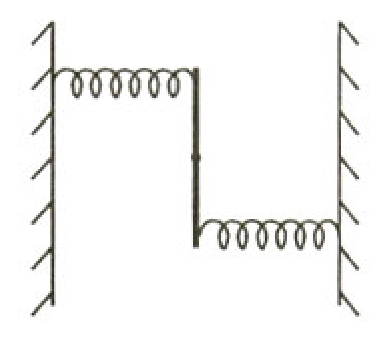
A uniform rod of length and mass is pivoted at the centre. Its two ends are attached to two springs of equal spring constants . The springs are fixed to rigid supports as shown in the figure, and the rod is free to oscillate in the horizontal plane. The rod is gently pushed through a small angle in one direction and released. The frequency of oscillation is
Options
Topics & Concepts
Step-by-Step Solution
To find the frequency of small oscillations of the system, we analyze the restoring torque acting on the rod when it is displaced by a small angle from its equilibrium position.
-
Restoring Torque:
The uniform rod of mass and length is pivoted at its center. Therefore, the distance from the pivot to each end of the rod is:
When the rod is displaced by a small angle , the displacement of each end from its equilibrium position is:
Since the springs are attached to the opposite ends, one spring is extended by while the other is compressed by . Each spring exerts a restoring force perpendicular to the rod given by:
Both forces create restoring torques about the central pivot in the same rotational sense:
-
Moment of Inertia:
The moment of inertia of a uniform rod of mass and length about an axis passing through its center of mass is:
-
Equation of Motion:
Applying Newton's second law for rotation, :
Dividing both sides by :
-
Frequency of Oscillation:
The angular frequency is:
Therefore, the frequency of oscillation is:
This corresponds to Option C.