IUPAC Name to Structure Matching for Ethynyl Hydroxy Acid
Determine which of the following chemical structures corresponds to the IUPAC name 3-ethynyl-2-hydroxy-4-methylhex-3-en-5-ynoic acid.
Options
A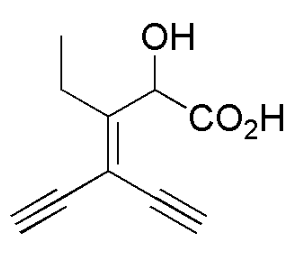
B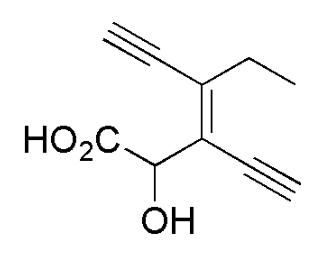
C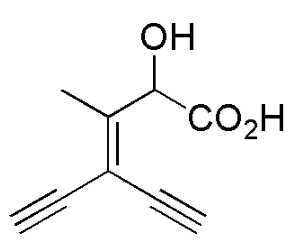
D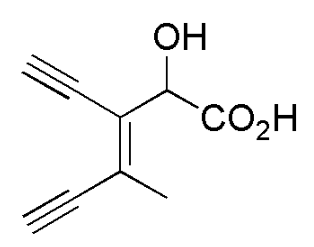 Correct
Topics & Concepts
Step-by-Step Solution
To determine the correct chemical structure corresponding to the IUPAC name 3-ethynyl-2-hydroxy-4-methylhex-3-en-5-ynoic acid, we break down the name into its structural components:
1. Identify the Principal Functional Group and Main Chain Numbering
- Principal Functional Group: Carboxylic acid ( or ), which takes highest priority. Thus, the carboxylic carbon is designated as .
- Main Chain Length: "hex" indicates a 6-carbon principal chain containing to .
- Position of Unsaturation:
- "3-en" indicates a double bond between and ().
- "5-yn" indicates a triple bond between and ().
2. Identify the Substituents and their Positions
- : Has a hydroxyl group (), giving the fragment .
- : Has an ethynyl substituent ().
- : Has a methyl substituent ().
3. Construct the Complete Structure
Combining these parts gives the structural formula:
- At : The alkene carbon is attached to the group and an ethynyl group ().
- At : The alkene carbon is attached to a methyl group () and the alkynyl chain ( which constitutes and ).
4. Evaluating the Options
- Option (A): The substituent at is an ethyl group (), not a methyl group.
- Option (B): The ethyl group is at the upper carbon, giving incorrect numbering and connectivity.
- Option (C): The methyl group is attached to , and has two ethynyl groups attached, which violates the main chain structure.
- Option (D):
- The upper alkene carbon () is attached to and an ethynyl group ().
- The lower alkene carbon () is attached to a methyl group () and an ethynyl group () forming and .
Thus, the structure in Option (D) perfectly matches the IUPAC name.
Correct Answer: (D)