Identify Identical Newman Projection Conformers
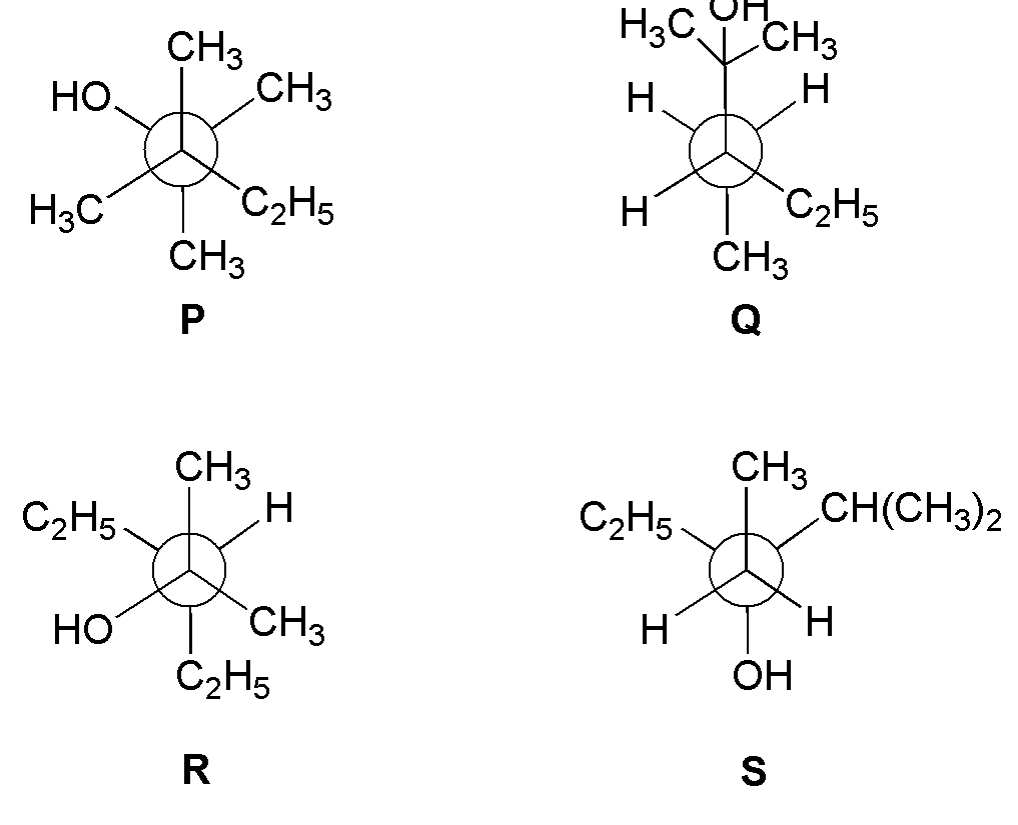
Four Newman projections denoted as , , , and are presented below:
Identify which option correctly represents a pair of identical molecules.
Options
and
and
and
and
Topics & Concepts
Step-by-Step Solution
To determine which option represents a pair of identical molecules, we determine the IUPAC structural formulas for each of the given Newman projections (, , , and ).
1. Analysis of Molecule
- Front Carbon (): Attached to two methyl groups () and one ethyl group ().
- Back Carbon (): Attached to two methyl groups () and one hydroxyl group ().
- IUPAC Name: 2,3,3-trimethylpentan-2-ol.
2. Analysis of Molecule
- Front Carbon (): Attached to two hydrogen atoms () and one methyl group (), which together form an ethyl group:
- Back Carbon (): Attached to:
- One hydrogen atom ()
- One ethyl group ()
- One -hydroxypropan--yl group ()
- The front carbon group ()
Thus, the central carbon () is bonded to two identical ethyl groups (), one hydrogen atom (), and one group.
- IUPAC Name: 3-ethyl-2-methylpentan-2-ol.
3. Analysis of Molecule
- Front Carbon (): Attached to two methyl groups () and one hydroxyl group ():
- Back Carbon (): Attached to:
- One hydrogen atom ()
- Two ethyl groups ()
- The front carbon group ()
Thus, the central carbon () is bonded to two identical ethyl groups (), one hydrogen atom (), and one group.
- IUPAC Name: 3-ethyl-2-methylpentan-2-ol.
4. Analysis of Molecule
- Front Carbon (): Attached to two hydrogen atoms () and one methyl group (), forming an ethyl group ().
- Back Carbon (): Attached to one ethyl group (), one isopropyl group (), and one hydroxyl group ().
- IUPAC Name: 3-ethyl-2,4-dimethylpentan-3-ol.
Conclusion
Both and represent 3-ethyl-2-methylpentan-2-ol:
Since the molecule has no stereocenters (C2 is attached to two identical methyl groups and C3 is attached to two identical ethyl groups), it is achiral. Therefore, and represent the identical molecule.
Correct Option: (C) and