Stereoisomeric Relationships of D Erythrose Isomers
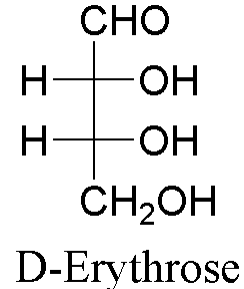
The Fischer projection of D-erythrose is depicted below.
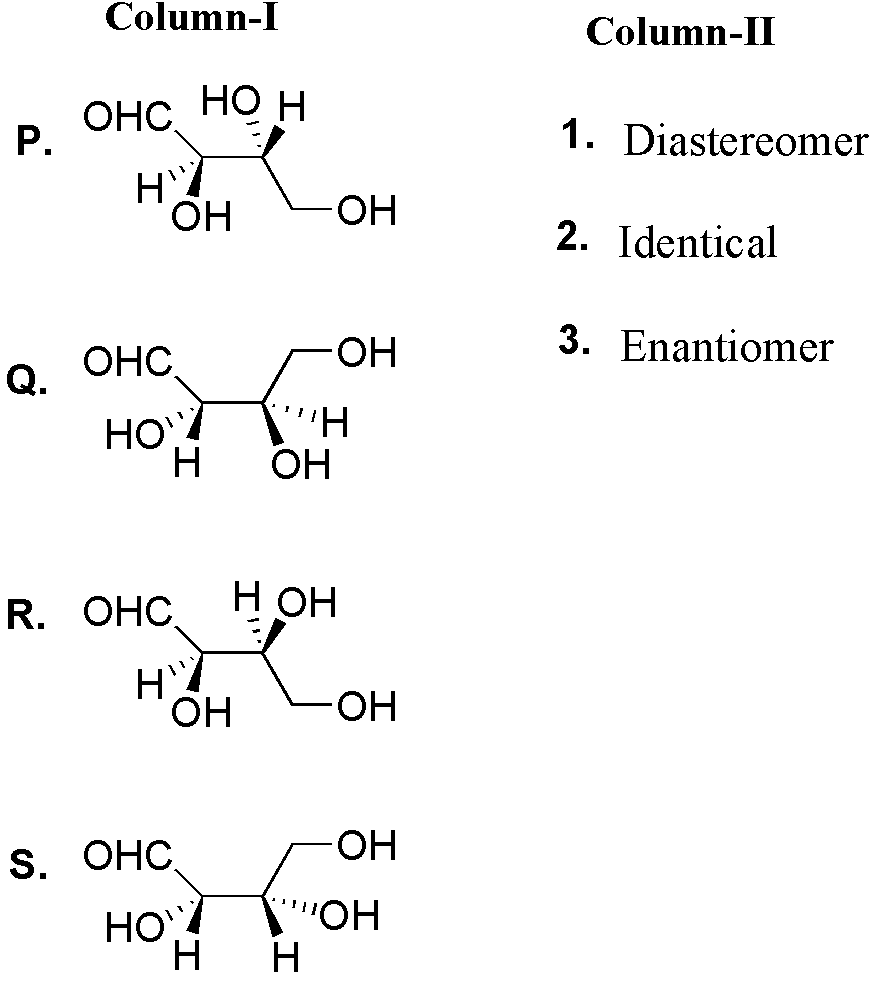
D-Erythrose and its corresponding isomers are designated as P, Q, R, and S in Column-I. Select the correct matching of P, Q, R, and S with D-erythrose from Column-II.
Options
A
B
C
Correct
D
Topics & Concepts
Step-by-Step Solution
To determine the correct relationships of structures P, Q, R, and S with D-erythrose, we determine the absolute configurations ( system) of the chiral centers ( and ) for D-erythrose and each compound.
1. Configuration of D-Erythrose
The Fischer projection of D-erythrose is:
Configuration at C2:
- Priority of groups attached to C2:
- (Priority 1)
- (Priority 2, attached to )
- (Priority 3, attached to )
- (Priority 4)
- Determining :
- Group 1 () is on the Right.
- Group 2 () is at the Top.
- Group 3 () is at the Bottom.
- Direction goes counter-clockwise.
- Since the lowest priority group () is on a horizontal bond, counter-clockwise corresponds to the configuration.
Configuration at C3:
- Priority of groups attached to C3:
- (Priority 1)
- (Priority 2, attached to )
- (Priority 3, attached to )
- (Priority 4)
- Determining :
- Group 1 () is on the Right.
- Group 2 () is at the Top.
- Group 3 () is at the Bottom.
- Direction goes counter-clockwise.
- With on a horizontal bond, counter-clockwise corresponds to the configuration.
Thus, D-erythrose has the configuration.
2. Analysis of Structures P, Q, R, and S
Structure P:
- C2 Center: The group is on a dashed bond (pointing away) and is on a wedged bond. Evaluating priorities gives the configuration.
- C3 Center: The group is on a wedged bond and is on a dashed bond. Evaluating priorities gives the configuration.
- Configuration of P: , which is Identical to D-erythrose.
Structure Q:
- C2 Center: The configuration is inverted relative to P, yielding .
- C3 Center: The configuration is retained relative to P, yielding .
- Configuration of Q: , which has one inverted stereocenter. Therefore, it is a Diastereomer of D-erythrose.
Structure R:
- C2 Center: The configuration is retained relative to P, yielding .
- C3 Center: The configuration is inverted relative to P, yielding .
- Configuration of R: , which has one inverted stereocenter. Therefore, it is a Diastereomer of D-erythrose.
Structure S:
- C2 Center: The configuration is inverted relative to P, yielding .
- C3 Center: The configuration is inverted relative to P, yielding .
- Configuration of S: , which is the non-superimposable mirror image of . Therefore, it is the Enantiomer of D-erythrose.
Conclusion
Thus, the correct option is C.